
Building the Possibility Set
Why Option A Always Wins by Default When You Skip This Step
THE BOTTOM LINE UP FRONT
Most leadership teams never actually choose their strategy.
They inherit one. They extend the current year’s plan. They tweak last year’s budget. They launch the initiative that everyone had already agreed to before the offsite began.
What they rarely do is build a genuine set of options and then choose among them.
That is the Possibility Set. And skipping it is why so many strategies feel like the only thing anyone could have done, right up until they stop working.
A choice is only real if there was something else you could have chosen.
THE OPTION A PROBLEM
Here is a pattern I see in almost every planning process I walk into.
The leadership team has been living with a problem for months. They have opinions. They have built convictions. By the time they sit down to do strategy work, Option A is not really on the table. It is the table.
The facilitated discussion, the offsite agenda, the consulting engagement, all of it is structured around arriving at a destination that was already chosen informally, in hallways and one-on-ones, long before the formal process began.
This is not cynicism. It is human. People (all of us) form views. Leaders especially.
But it’s a problem. Because Option A, the obvious move, the safe extension of the current direction, is often the wrong choice. Markets shift. Assumptions decay. Technology changes. What worked last year may not work next year.
Defaulting to the familiar is not strategy. It is inertia with a slide deck.
WHAT THE POSSIBILITY SET IS
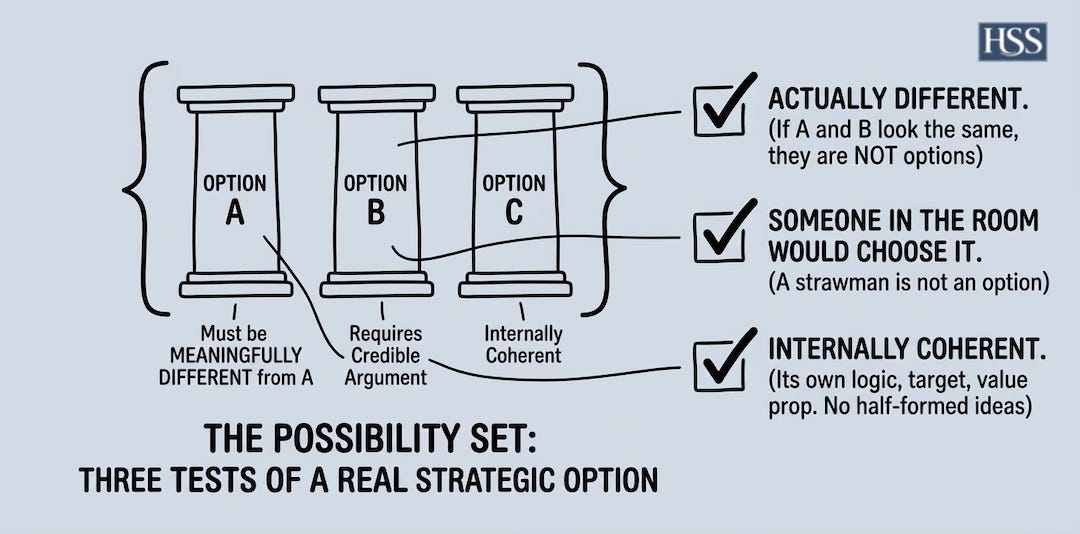
The Possibility Set is a structured collection of two or three genuine strategic options. Not variations on a theme. Not slight adjustments to the current plan. Real alternatives that each represent a different answer to the strategic problem you named in the March 31 post, The Strategic Problem Statement.
Each option in the set should pass four tests.
It is actually different.
If you squint and Options A and B look the same, you have one option with cosmetic variation. That does not count. A real option takes you somewhere meaningfully different.
Someone in the room would choose it.
If no rational person would pick Option C, it is a strawman, not an option. Every option in the set should have a credible case behind it.
It is internally consistent.
Each option should have its own logic. Its own target customer, its own value proposition, its own competitive rationale. A half-formed idea is not an option.
It forecloses something.
Real strategic choices say no to something. If Option B does not require giving anything up, it is not a real strategy. It is a wish list.
If every option is comfortable, you have not built a Possibility Set. You have built a list of things you were already going to do.
HOW TO BUILD GENUINE OPTIONS
The hardest part of building the Possibility Set is not generating ideas. It is generating ideas that are genuinely different from the current direction.
Here are four moves that reliably surface real options.
Start with the customer, not the product. Ask: Who else could we serve that we currently ignore? What would we have to change to reach them? This often reveals a market adjacency or a segment expansion that the current plan does not consider.
Ask what you would do if your biggest asset disappeared. If you lost your largest client, your lead product, or your most important distribution channel, what would you build instead? Constraint thinking surfaces alternatives that comfort thinking never reaches.
Look at what competitors are not doing. In every market, there are moves no one is making. Sometimes that is because those moves are bad ideas. Sometimes it is because everyone is following the same assumptions. Asking why a space is empty often reveals an option worth considering.
Consider the exit logic. If you were going to sell the company in three years, what would you build to maximize its value? That target state often defines a strategic option that pure operating logic would not generate.
You do not need a dozen ideas. You need two or three that are genuinely different and genuinely defensible.
A STORY ABOUT OPTIONS THAT CHANGED EVERYTHING
I worked with a professional services firm that had been growing steadily for a decade. Revenue was solid. The team was good. The obvious Option A was to keep doing what was working, hire more people, and serve more clients in the same segment.
We pushed them to build a real Possibility Set.
Option B: stop serving small and mid-size clients entirely and reposition as a high-fee specialist for a narrower, larger client base. Fewer clients, deeper relationships, significantly higher margins.
Option C: productize their core methodology into a licensed training program and sell it to firms that could not afford their direct fees. Different business model, different growth ceiling, different risk profile.
Option A still won. But it won differently. The team stress-tested it against B and C and came out with sharper clarity about why they were choosing it and what it would require. They made specific commitments they had never made before, around client minimums, service boundaries, and hiring profiles.
That is what a real Possibility Set does. Even when you end up at the obvious choice, you arrive there with more conviction and more discipline. At a minimum, more insight and a little humility.
THE CONNECTION TO CHOICE
In Strategy Is Choice, Not Aspiration (March 3), we covered the idea that strategy is choice, not aspiration. Roger Martin’s framework, the strategy cascade, starts with a winning aspiration and then forces choices about where to play and how to win.
The Possibility Set is where those choices get structured.
You cannot choose where to play if you have only one place on the map. You cannot choose how to win if you have only one theory of winning. The Possibility Set forces the team to put multiple answers on the table before any of them are selected.
This is also where the problem statement from Week 10 does its work. A clear problem statement shapes which options are relevant. If the problem is customer churn, Option A should address churn. If it does not, it belongs in a different conversation.
The Possibility Set is not brainstorming. It is a structured option generated in response to a named problem.
WHAT HAPPENS AFTER THE POSSIBILITY SET
The Possibility Set is not the endpoint. It is the setup for the next moves in the Sprint.
Once you have two or three genuine options, the next question is: what would have to be true for each one to succeed? That is the WWHTBT framework we will cover in the April 21 post. It is the core logic test that separates wishful thinking from testable strategy.
In the Sprint, the Possibility Set typically takes the middle two weeks to build properly. It is not a one-session exercise. Options need to be drafted, challenged, thought about, refined, and stress-tested before they are ready for validation.
Teams that do this well arrive at their final strategy choice with something rare: confidence they can explain. Not just conviction that they are right, but a clear account of what they considered and why they chose what they chose.
Boards respond to that. Investors respond to that. Executive teams execute better because of that.
YOUR MOVE THIS WEEK
Take the strategic problem you identified last week. The one sentence that describes the actual challenge.
Now write down your current answer to it. The direction you are heading. That is your Option A.
Then ask two questions:
What is a meaningfully different answer to this same problem that a reasonable person could argue for?
What would we have to give up to pursue it?
If you cannot answer the second question, you haven’t yet found a real option.
That discomfort is useful. It means you are doing strategy, not planning.
Next week: What Skydiving Taught Me About Preparation. A personal piece on why the work you do before the jump determines everything about the jump itself. Connects directly to why the Sprint invests 30 days in diagnosis before committing to direction.
If your team is stuck at Option A and you know it, the Sprint is designed to get you unstuck. Learn more about the Strategy Sprint at Haas Strategy Solutions.