
Strategy is Choice, Not Aspiration
Why a Mission Statement Is Not a Strategy
Most companies do not have a strategy. They have aspirations.
They have mission statements about being the leading provider or delivering exceptional value. They have vision statements about transforming industries. They have core values lists, annual goals, and thick planning documents.
None of that is strategy.
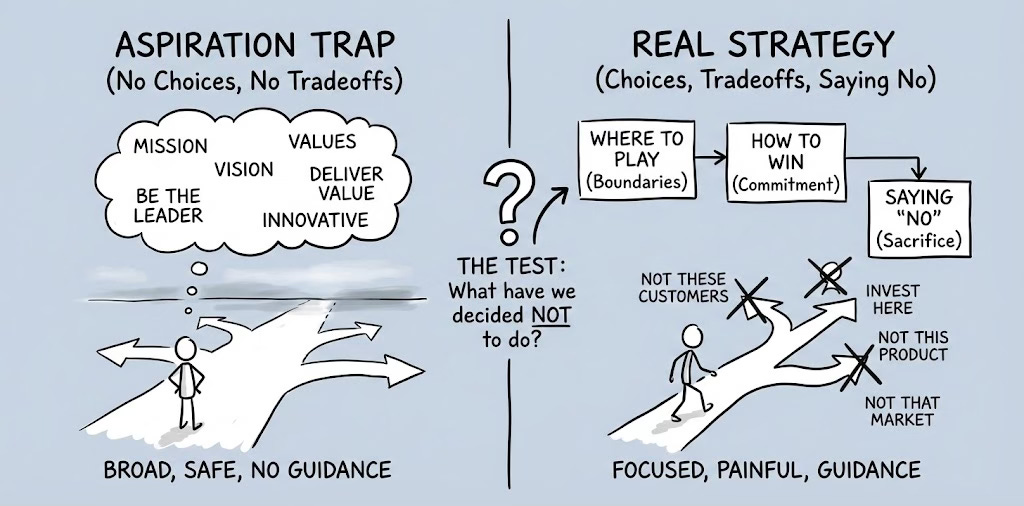
Strategy is choice. Specifically, it is choosing where to compete and how to win, and, just as important, choosing what you will not do.
The Aspiration Trap
Aspirations are comfortable. “We will be the preferred partner for innovative solutions” offends no one. It commits to nothing. It requires no sacrifice.
Strategy is uncomfortable. It says: we will serve these customers and not those. We will compete on this basis and not that. We will invest in these capabilities and let others atrophy.
The reason most companies have aspirations instead of strategy is that strategy requires saying no. And saying no is hard.
Saying no to a customer segment means walking away from revenue. Saying no to a product line means admitting it was a mistake. Saying no to a geographic market means telling someone their pet project is over.
Leaders avoid these conversations. Instead, they write mission statements broad enough to include everything. They call it strategy. It is not.
What Real Strategy Looks Like
Roger Martin, who has studied strategy for decades, defines it as an integrated set of choices that positions an organization to win. The key word is choices.
A real strategy answers five questions. What is our winning aspiration? Where will we play? How will we win? What capabilities must we have? What management systems do we need?
The hard work is in questions two and three. Where will we play forces you to define boundaries. How will we win forces you to commit to a way of competing that is different from your rivals.
If your answer to “how will we win” is “by being better,” you do not have a strategy. Everyone claims to be better. The question is: better at what, for whom, in a way competitors cannot easily match?
The Test
Here is a simple test for whether you have strategy or aspiration.
Look at your strategy document and ask: what have we decided not to do because of this?
If the answer is nothing, you have an aspiration.
A real strategy closes doors. It says: we will not pursue customers who buy primarily on price. We will not expand into markets where we lack the capabilities to win. We will not build products that dilute our focus.
These are painful commitments. That is why they matter. If your strategy does not hurt a little, it is not making real choices.
Why This Matters When Pressure Arrives
Aspirations collapse under pressure. When revenue drops or a competitor attacks, a broad mission statement gives you no guidance. Everything seems worth protecting. Resources get spread thin. The organization flails.
Strategy provides a decision framework. When pressure arrives, you know what to protect and what to sacrifice. You know which customers matter most and which you can afford to lose. You know where to double down and where to retreat.
This is not about being rigid. Strategy should adapt as conditions change. But adaptation requires something to adapt from. A clear set of choices can be revised. Vague aspirations just dissolve.
The Possibility Set
In the Sprint process I use with clients, we force choices through what I call the Possibility Set. Before committing to any direction, we articulate three to five genuinely different strategic options.
Not variations on a theme. Different answers to “where will we play” and “how will we win.”
Option A might be: focus on enterprise customers in the Northeast, competing on integration and support. Option B might be: expand to mid-market nationally, competing on price and simplicity. Option C might be: build a platform that others sell, competing on ecosystem and reach.
These are different strategies. Each requires different capabilities, different investments, different tradeoffs.
The discipline of generating real options prevents premature commitment. It forces you to see alternatives before you choose. And when you do choose, you know what you are choosing against.
What Would Have to Be True
After generating options, we ask: what would have to be true for each option to be a winning strategy?
This is not “what do we hope is true.” It is the conditions that must hold for the strategy to work.
For Option A to win, it might require: enterprise buyers value integration enough to pay a premium, our support capability is genuinely superior, and competitors cannot match our integration depth within three years.
For Option B, the conditions are different: mid-market buyers are underserved by current options, our cost structure allows sustainable low pricing, and scaling nationally does not require capabilities we lack.
Writing out these conditions turns strategy from argument into analysis. Instead of debating opinions, you test assumptions. You figure out which uncertainties matter most. You make better choices.
The Work Ahead
If you do not have a strategy, you have work to do. Not mission statement work. Choice work.
Start by articulating where you actually compete today. Not where you want to compete. Where you win and why. Then ask: is this where we should compete going forward? If not, what changes?
The goal is a small number of clear commitments. Customers you will serve. Ways you will win. Capabilities you will build. Things you will stop doing.
That is strategy. Everything else is aspiration.