
The Strategic Problem Statement
Why Solving the Wrong Problem Is Worse Than Having No Strategy at All
THE BOTTOM LINE UP FRONT
Most leadership teams are solving the wrong problem.
Not because they are careless. Because naming the actual problem is harder than it looks, and skipping that step is faster. So they move straight to solutions, initiatives, and roadmaps built on a problem nobody formally agreed on.
This is the single most common reason strategy fails.
If you solve the wrong problem brilliantly, you still lose.
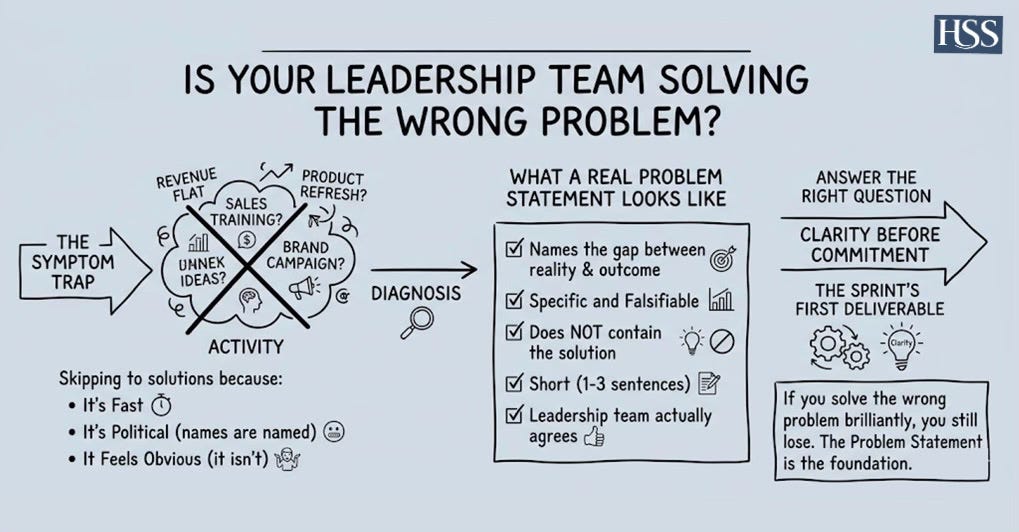
THE SYMPTOM TRAP
Here is how it usually goes.
Revenue is flat. The leadership team gathers. Someone says the sales team needs better training. Someone else says the product needs a refresh. A third person says the brand is tired and needs a campaign.
Three weeks later, there are three new initiatives underway. Revenue is still flat.
What nobody asked: why is revenue flat?
Flat revenue is a symptom. It could mean many things. Customers are churning faster than new ones arrive. The market segment you serve is shrinking. A competitor has undercut your price. Your best salespeople left. Your product solves a problem customers used to have but no longer do.
Each of those is a different problem. Each requires a different response. Launching a sales training program when the real issue is a shrinking market segment does not fix anything. It just creates activity.
Activity is not strategy. Busy is not the same as effective.
WHY TEAMS SKIP THE PROBLEM STATEMENT
The problem statement step gets skipped for predictable reasons.
It is slow. Writing a clear problem statement requires conversation, debate, and often a few uncomfortable revelations. That takes time. The team would rather start doing.
It is political. The real problem often implicates someone in the room. Naming it means naming whose decisions, assumptions, or territory are part of the issue. That is uncomfortable.
It feels obvious. Leaders often assume everyone already agrees on the problem. They rarely do. The agreement is usually surface-level. Push one layer deeper and the versions diverge fast.
I learned this in the field, watching ecologists describe the same system in completely different terms depending on what they were trained to see. A soil scientist and a wildlife biologist standing in the same wetland see entirely different problems. Leadership teams are no different.
WHAT A REAL PROBLEM STATEMENT LOOKS LIKE
A good problem statement does five things.
It names the gap between current reality and desired outcome.
It is specific enough to be falsifiable. You could imagine evidence that says the problem is solved.
It does not contain the solution. If your problem statement says ‘we need a new CRM,’ that is a solution, not a problem.
It is short. One to three sentences. If it takes a paragraph to describe the problem, the problem has not been diagnosed yet.
The leadership team agrees on it. Not nods-in-a-meeting agrees. Actually agrees.
Here is what a weak problem statement looks like:
“We need to grow revenue by improving our go-to-market strategy and investing in customer success.”
That is a solution list dressed up as a problem statement. It assumes the cause and prescribes the response before any diagnosis.
Here is what a stronger version looks like:
“We are losing mid-market customers within 18 months of acquisition at a rate that offsets new customer growth, and we do not have a shared understanding of why.”
That version names the gap, points to what we do not know, and leaves the solution open. Now the team can actually work the problem.
THE PROBLEM BEHIND THE PROBLEM
The most useful discipline in problem statement work is asking one question repeatedly:
“Is that the problem, or is that a symptom of the problem?”
Revenue is flat. Is that the problem? Or a symptom?
Customer churn is high. Problem or symptom?
The sales team is underperforming. Problem or symptom?
Keep asking until you hit something that does not dissolve into a deeper layer. That is the problem worth solving.
In ecology, this is the difference between treating an invasive species and asking why native species stopped competing effectively. One is a response. The other is a diagnosis.
The diagnosis takes longer. It is worth it.
A STORY FROM THE FIELD
Consider a manufacturing company in the mid-Atlantic losing market share. The leadership team was convinced the problem was pricing. A competitor had come in low and was taking contracts.
Now run the problem statement process before anyone touches a spreadsheet.
What surfaces is on-time delivery rate dropped from 94 percent to 81 percent over 18 months. Customers were not leaving because of price. They were leaving because delivery had become unreliable, and the competitor’s lower price made the switch easy to justify.
The pricing problem was real but secondary. The delivery problem was primary.
A pricing response would have cut margin and not stopped the churn. The actual fix was in operations.
They never would have found it without the problem statement work.
HOW THE SPRINT USES THIS
In a Strategy Sprint, the problem statement is the first deliverable and the hardest one. We don’t move forward until the leadership team agrees on it.
This often takes more time than people expect. That isn’t a failure. It’s the work.
Last week, I described the Sprint as delivering clarity before commitment. The problem statement is where that clarity starts. Everything else, the possibility set, the business model canvas, the priority uncertainties, builds on top of it.
A weak problem statement produces a well-executed response to the wrong situation. A clear problem statement makes every subsequent decision faster and more defensible.
Sprint does not guarantee the right answer. It guarantees you are answering the right question.
YOUR MOVE THIS WEEK
Try this before your next planning conversation.
Write down your company’s single most important strategic challenge in one sentence. Then ask two or three of your senior leaders to do the same, independently.
Compare the sentences. Look for three things:
Do they describe the same gap?
Do any of them contain a solution hidden inside the problem description?
Does anyone describe a symptom where someone else describes a root cause?
What you find in that comparison is more useful than most strategy offsite agendas.
That is where the real work begins.
Next week: Building the Possibility Set. Before you choose a direction, you need genuine options on the table. Most teams default to Option A without realizing they never built a real Option B (or C).