
What Is a Strategy Sprint?
The Fast Alternative to Six-Month Strategy Engagements That Go Nowhere
THE BOTTOM LINE UP FRONT
Most strategy engagements take too long to produce anything useful.
You hire a consultant. Three months later, you have a thick report, a slide deck, and a roadmap that was outdated before the ink dried.
There is a better way to start. It is called a Strategy Sprint.
A Sprint is 30 days of structured work that delivers clarity on the real problem, your realistic options, and the logic connecting them. It does not produce a final strategy. It produces the foundation you need to build one.
Thirty days. Five deliverables. Clarity without premature commitment.
WHAT A SPRINT IS NOT
Before describing what a Sprint is, it helps to clear out the lookalikes.
A Sprint is not a discovery phase. Discovery phases in traditional consulting are open-ended. The consultant learns about your business, interviews stakeholders, and eventually proposes a scope of work. That can take months and often leads to a larger engagement, whether you need one or not.
A Sprint is not a strategic plan. A strategic plan has budgets, timelines, and accountability structures. It is the output of the strategy, not the strategy itself. SPRINT does not produce a plan. It produces the clarity needed to make a plan worthwhile.
A Sprint is not a workshop. A one-day or two-day offsite can surface energy and ideas. What it rarely produces is a disciplined analysis of your actual competitive position. Good intentions are not a substitute for a structured diagnosis.
The Sprint is none of these. It is something more specific.
WHAT A SPRINT IS
A Strategy Sprint is a 30-day structured engagement focused on one question: what is the real problem, and what are the genuine options for addressing it?
That sounds simple. It is not easy.
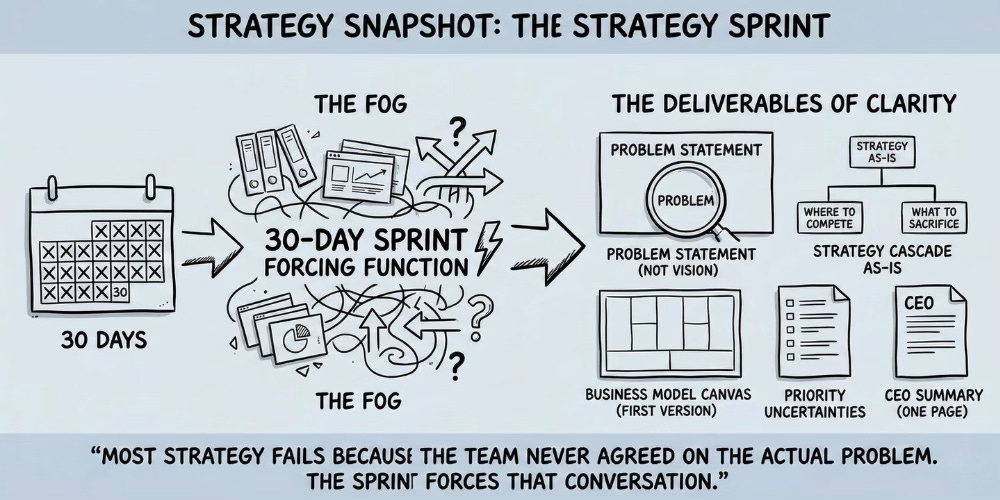
Most leadership teams have never formally named their strategic problem. They have symptoms, challenges, goals, and concerns. They do not have a crisp, agreed-upon problem statement. The Sprint starts there.
In Week 10, we will go deep on the problem statement. For now, understand this: if your team cannot agree on the problem in one sentence, you are not ready to choose a direction. The Sprint creates that agreement.
THE FIVE SPRINT DELIVERABLES
A Sprint produces five things. Each one is concrete. Each one is yours to keep.
1. Problem Statement
A single, agreed sentence describing the core strategic challenge. Not symptoms. Not goals. The actual problem.
2. Strategy Cascade (As-Is)
A map of your current strategy: your winning aspiration, where you play, how you compete. This is often the first time a leadership team has made this explicit. It is almost always revealing.
3. Business Model Canvas v1
A structured view of how your business actually creates and captures value today. This is the starting point for evaluating whether your strategy and your business model are aligned.
4. Priority Uncertainties
The assumptions have high stakes and low confidence. These are the things you must figure out before committing significant resources. Naming them is not a weakness. It is an intellectual discipline.
5. CEO Summary
A one-page synthesis of the above. If your strategy cannot fit on one page, it is not clear enough yet. The CEO Summary is designed for board conversations, investor discussions, and team alignment.
If you cannot explain your strategy on one page, the problem is not the page.
WHO THE SPRINT IS FOR
Not every company needs a Sprint. Some leadership teams already have clarity. They know their problem. They have a working model. They need execution discipline, not diagnosis.
But a Sprint is the right starting point in three situations.
New CEO. You have inherited someone else’s strategy and someone else’s assumptions. Before you commit to a direction, you need to know what is actually true. The Sprint gives you that map without requiring you to blow up the organization in the process.
Major decision pending. An acquisition. A new market. A significant pivot. These are the moments when clarity is most valuable and most absent. The Sprint forces the diagnosis before the commitment.
Strategy debt. The team has been executing on momentum, not strategy. The original logic has drifted. Nobody has stopped to ask whether you are still playing the right game. The Sprint creates that pause.
If any of those fit, keep reading.
HOW 30 DAYS WORKS
The Sprint is structured, not open-ended. The work happens in three phases.
Week 1: Diagnosis. We map current reality. Leadership team interviews. Financial and competitive review. Problem statement drafts. This is where the metaphor exercise from Week 8 pays off. We want to know how the team sees the organization, not just how the org chart describes it.
Weeks 2-3: Possibility Set. We build two or three genuine strategic options. Not variations on the current plan. Real alternatives. Option A does not win by default in a well-run Sprint. The team has to look hard at Options B and C before committing.
Week 4: Synthesis. We complete the five deliverables and stress-test the logic. The CEO Summary is drafted. The priority uncertainties are named. The leadership team is aligned on the problem, the options, and the next questions to answer.
Thirty days. Structured work. Real output.
THE CONNECTION TO CHOICE
In Week 6, we covered the idea that strategy is choice, not aspiration. A mission statement is not a strategy. Real strategy requires specific decisions about where to play and what to say no to.
SPRINT creates the conditions for those choices.
You cannot make good choices without an honest picture of current reality. You cannot make good choices without genuine options on the table. You cannot make good choices when your leadership team is arguing from different maps.
SPRINT addresses all three. It is not the strategy. It is what makes strategy possible.
YOUR MOVE THIS WEEK
One diagnostic question:
If your top three leaders each wrote one sentence describing your current strategic challenge, would the sentences be compatible?
Not identical. Compatible.
If the answer is yes, your team has the shared picture needed to move forward. If the answer is no or you are not sure, that is your starting point.
SPRINT is designed for exactly this situation.
Next week: The Strategic Problem Statement. Why naming the actual problem is harder than it sounds, and what happens when teams skip it.