
The CEO Can’t Delegate Strategy
CEOs try to delegate strategy. It does not work.
They hire consultants to develop options. They assign strategy to a chief strategy officer. They form committees. They run workshops where everyone contributes ideas.
None of this is wrong. Input is valuable. Analysis helps. But at the moment of decision, strategy cannot be delegated.
Here is why.
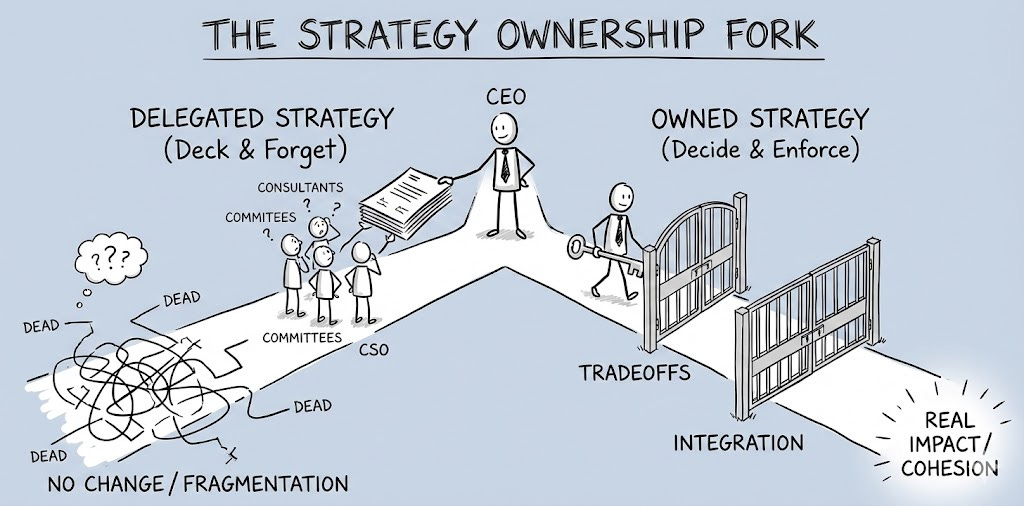
Strategy Requires Tradeoffs
As I wrote last week, strategy is choice. Real strategy closes doors. It says: we will serve these customers and not those, compete this way and not that, invest here and not there.
Tradeoffs create losers. The business unit that loses investment. The executive whose pet project gets cut. The function that shrinks while another grows.
Only the CEO has the authority to make those calls stick. A chief strategy officer can recommend. A consultant can analyze. But when someone’s budget gets cut or their initiative gets killed, they will appeal. They will escalate. They will work around.
If the CEO did not make the decision, it will not hold.
Strategy Requires Integration
A company’s strategy must hold together. The market position, the capabilities, the operating model, the financial structure, they all need to fit.
No one else sees the whole picture. The head of sales sees the market. The head of operations sees the cost structure. The CFO sees the financials. The head of product sees the roadmap.
Only the CEO sits at the intersection. Only the CEO can see where the pieces connect and where they conflict. Only the CEO can make the judgment calls when functions want different things.
Delegation fragments this view. Each delegate optimizes their piece. The whole suffers.
What Happens When CEOs Try to Delegate
I have seen the same pattern many times.
A CEO hires a strategy consulting firm. The firm does excellent analysis. They produce a thick deck with market data, competitive benchmarks, and three strategic options.
The CEO reviews the deck. They pick Option B. They announce the new strategy. They move on to other priorities.
Six months later, nothing has changed. The organization is still doing what it was doing before. Middle managers ignored the new direction because the CEO did not enforce it. Executives pursued their own agendas because the CEO did not resolve conflicts.
The strategy was never real. It was a document the CEO approved, not a set of choices the CEO owned.
Owning Means Deciding, Enforcing, and Revising
CEO ownership has three parts.
First, the CEO must decide. Not approve someone else’s recommendation. Decide. This means understanding the options deeply enough to defend the choice. It means being able to explain why this path and not that one. It means being ready to answer when a board member or investor asks hard questions.
Second, the CEO must enforce. When an initiative contradicts the strategy, the CEO kills it. When a leader works around the direction, the CEO corrects them. When resource allocation drifts, the CEO pulls it back. This is not micromanagement. It is making strategy real.
Third, the CEO must revise. Conditions change. Assumptions prove wrong. The CEO must notice when the strategy needs adjustment and have the authority to adjust it. A delegated strategy becomes rigid because the delegates lack permission to change it.
The Role of Help
None of this means the CEO works alone. Good strategy requires input the CEO cannot generate themselves.
Consultants can bring outside perspective. They see patterns across industries. They ask questions insiders have stopped asking. They challenge assumptions that have become invisible.
Staff can do analysis. They can gather data, model scenarios, and prepare options. They can identify uncertainties and surface risks.
The leadership team can test thinking. They know the organization’s capabilities and limits. They see implementation challenges the CEO might miss.
All of this is valuable. But it is input to a decision, not a substitute for one.
The CEO takes the input, makes the choice, and owns the result. The moment that ownership transfers to someone else, the strategy loses force.
What This Means for How I Work
When I work with clients, I do not deliver a strategy deck and leave. I work with the CEO to build their capability to make and own strategic choices.
The Strategy Maturity Session is a conversation with the CEO, not a presentation to them. We assess where they are, what they understand, what they are avoiding. The output is clarity about what the CEO needs to decide, not a decision made for them.
In Sprint, we generate options and test logic together. The CEO is in the room, wrestling with tradeoffs, not reviewing a finished product.
This is harder than handing over a deck. It is also the only way strategy becomes real.
The Question for You
If you are a CEO, ask yourself: do I own my company’s strategy?
Not “did I approve it.” Do I own it?
Can I explain, without notes, where we compete and why we win? Can I articulate what we stopped doing because of this strategy? Do I enforce it when people drift?
If the answers are no, you have a strategy document. You do not have a strategy.
The work is yours. No one else can do it for you.
Mark, this reminds me of a client I worked with in Singapore. Mr. Kim, the founder of the firm and I were having dinner on one of his rare visits to the States. I asked hm why his firm, which worked only with countries or multinational corporations was so successful. He answered, We are successful because we refuse to work with any organization where the man or woman in charge will not personally lead the change required in the organization. It will not happen if the objective is delegated. That visit happened just after his company had been the catalyst to shift of banking in Vietnam from hand records to digital.