
Priority Uncertainties
Not All Uncertainty Is Equal. Here's How to Find the Kind That Matters.
THE SHORT VERSION
Run ‘What Would Have to Be True’ on three strategic options and you might end up with 15 conditions on your list. Could be more.
The temptation is to treat them equally, assign someone to research each one, and reconvene in a month. That approach burns time and misses the point.
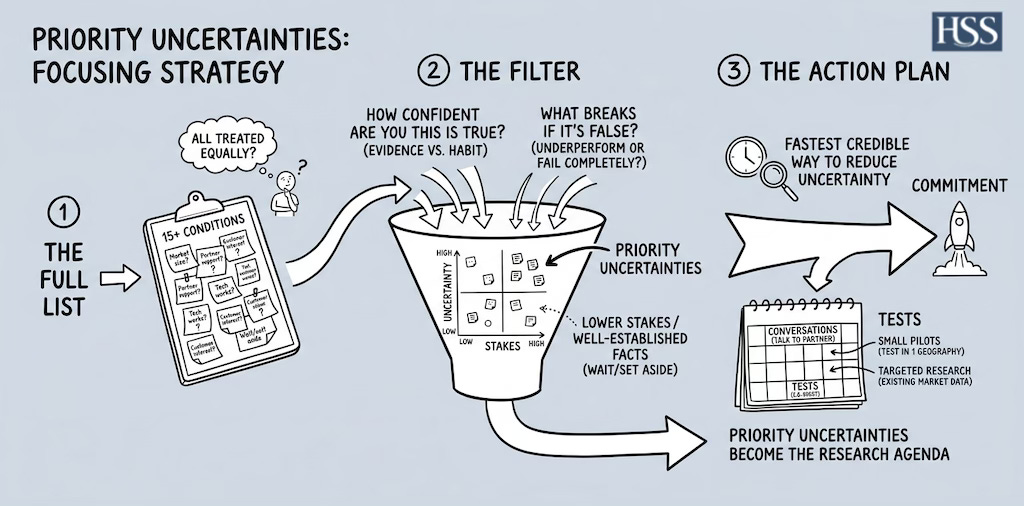
The conditions on a WWHTBT list aren’t equivalent. Some are well-established facts that don’t need investigation. Some are uncertain but won’t hurt the strategy much even if they’re wrong. And a few are both uncertain and load-bearing. Those are your priority uncertainties. They’re where the work needs to go before you commit.
A priority uncertainty is an assumption with high stakes and low confidence. Everything else can wait.
HOW TO SORT THE LIST
Two questions tell you which conditions belong at the top.
First: how confident are you that this condition is currently true? Not confident in principle. Specifically. What evidence do you have? When did you last check? ‘We’ve always assumed this’ isn’t confidence. It’s a habit (one we need to break).
Second: what breaks if this condition turns out to be false? Does the option underperform, or does it fail completely?
Run those two questions against your list and it sorts itself. High-stakes and uncertain ones go to the top. Certain conditions or low-consequence conditions can wait or be set aside.
A manufacturing firm near Frederick ran this exercise on a planned market expansion. They had eleven conditions on their WWHTBT list. Nine were either well-established or relatively low-consequence. Two were neither. Both involved the same thing: whether their primary distribution partner would actively support the new territory, or treat it as a low-priority extension of their existing relationship.
Nobody had asked the partner directly. The expansion plan assumed active support. The entire unit economics depended on it.
That’s a priority uncertainty. Two questions, fifteen minutes of honest discussion, and the whole research agenda reorganized itself.
WHAT TEAMS DO INSTEAD
The most common alternative is researching what’s comfortable. Teams gravitate toward conditions they can answer quickly, or conditions that will confirm what they already believe. The spreadsheet fills up. The work feels thorough. The high-stakes uncertain assumptions stay untouched because addressing them requires going somewhere uncomfortable, usually outside the organization, to hear something that might not be welcome.
There’s also a version where teams name their priority uncertainties correctly and then don’t act on them. That’s bad. They get listed in the strategy document as ‘areas requiring further study,’ and the plan proceeds anyway. Also bad. That’s not risk management. It’s documentation of a known problem while ignoring it.
Naming a priority uncertainty without investigating it is just a more organized way of not knowing what you’re doing.
THE INVESTIGATION QUESTION
Once you’ve identified your priority uncertainties, the next question is: what’s the fastest credible way to reduce the uncertainty before committing resources?
Sometimes that’s a conversation. Talk to the distribution partner. Ask directly. The answer might be uncomfortable, but it takes a week, not a quarter.
Sometimes it’s a small test. A pilot program in one geography before committing to three. A single client engagement in a new segment before restructuring the whole delivery team.
Sometimes it’s external research. Relevant market data exist, you just haven’t looked for it. Trade associations, regulatory filings, competitor reports, and customer surveys from industry groups.
The point is to match the investigation to the uncertainty, not to run a comprehensive research project that takes six months and produces more uncertainty than it resolves. Priority uncertainties deserve fast, specific answers.
HOW THIS CONNECTS TO BUILD
In a Strategy Sprint, identifying priority uncertainties is one of the five deliverables. The analysis tells you what you know well enough to act on and what you don’t. The CEO Summary captures both.
When an organization moves from Sprint to Build, the priority uncertainties become the research agenda. Build is largely the work of going out and testing those conditions against reality. Customer interviews, partner conversations, pilot programs, competitive analysis. The priority uncertainties from Sprint tell you exactly where to look.
If all you do is Sprint, you leave with clarity. You understand the problem, you have genuine options, and you know what you’d need to believe for each option to succeed. That’s valuable. But the most consequential assumptions are still open. Build is what closes them.
YOUR MOVE THIS WEEK
Take your WWHTBT list from last week’s exercise, or build one now for your current strategy.
Sort it. Which conditions, if false, would cause the strategy to fail rather than underperform? Which of those do you have strong evidence for, and which are you essentially assuming?
The ones at the intersection of ‘would cause failure’ and ‘we’re assuming rather than knowing’ are your priority uncertainties. Write them down explicitly.
Then ask: what’s the fastest credible way to get a real answer on each one?
That’s your research agenda. Everything else is secondary.
Next week: The One-Page CEO Summary. Sprint’s final deliverable and the test of whether the strategy is actually clear enough to act on.
If your team has named its priority uncertainties but isn’t sure how to investigate them, that’s exactly where the Sprint-to-Build conversation starts. Learn more about the Build engagement at HSS.