
What Would Have to Be True?
The Six-Word Question That Separates Testable Strategy from Wishful Thinking
THE SHORT VERSION
Every strategic option rests on conditions that have to hold for it to work. Most leadership teams never write those conditions down.
They pick a direction. Build a plan. Get moving. The assumptions underneath stay invisible, untested, and occasionally wrong in ways that matter quite a lot.
There’s one question that fixes this.
“What would have to be true” for this option to succeed?
Six key words. The real trick is to actually answer the question.
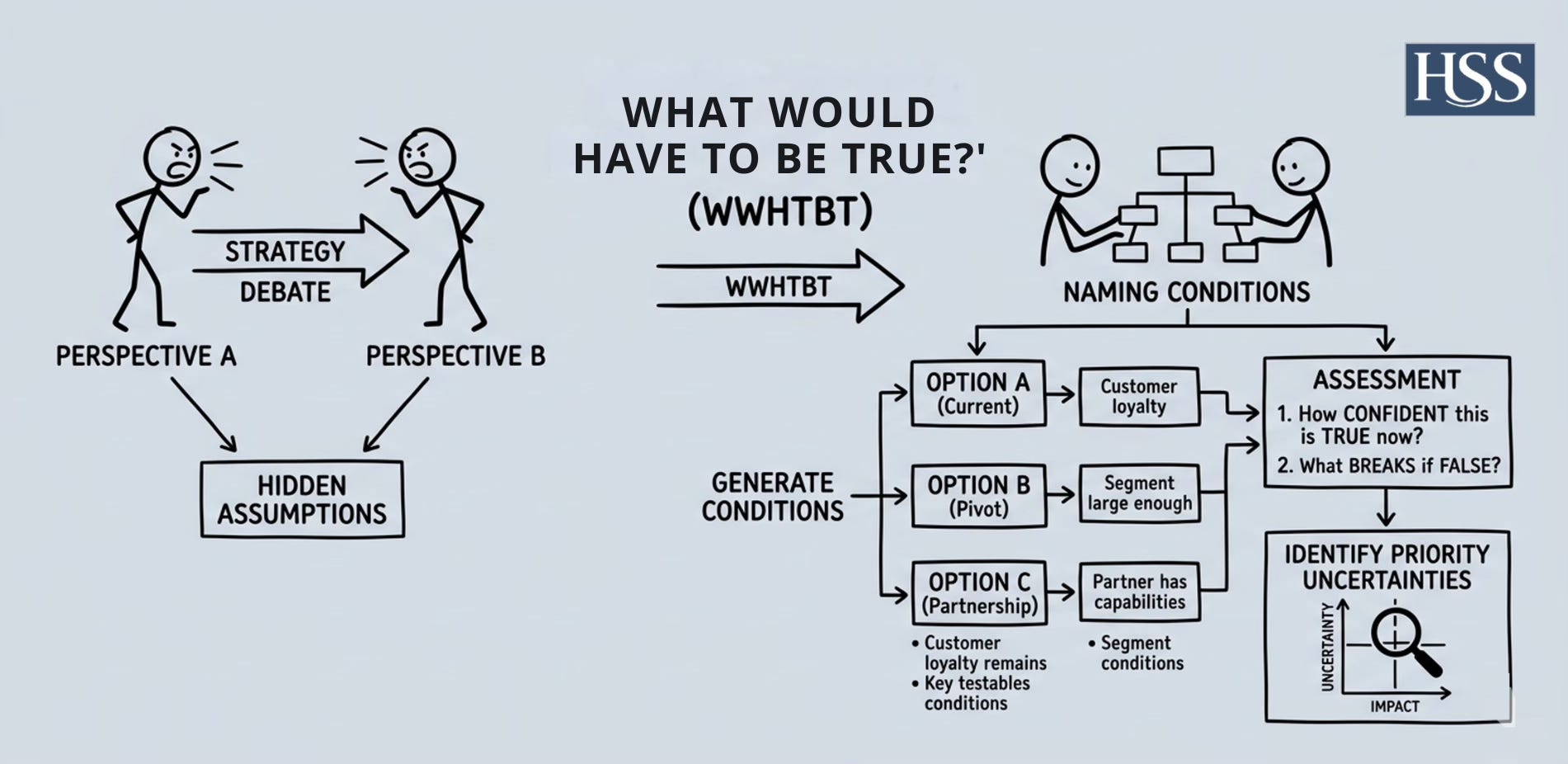
WHY STRATEGY DEBATES GO NOWHERE
Sit in enough planning meetings and you’ll see the same pattern. Someone pushes for Option A. Someone else proposes Option B. They go around the table. Positions get restated in slightly different language. The meeting ends with a decision, a stalemate, or enough ambiguity that everyone can claim they got what they wanted.
Nobody examined the assumptions underneath either position. The debate was about conclusions, and conclusions are hard to test.
Roger Martin, who did strategy work at P&G for years and wrote one of the most useful books on strategy I know of, identified why this happens. The real disagreement isn’t about the option. It’s about what each person believes to be true about the world. Those beliefs stay hidden inside the argument. Surface them and you can actually examine them.
WWHTBT is how you surface them.
When you ask what would have to be true for your preferred option to succeed, you stop defending a conclusion, surface biases, and start naming conditions. Market conditions. Customer behavior. Operational performance. Competitor response. Things that have to hold for the option to work. Some are well-established. Some are guesses nobody has checked in two years. Many are grounded in irrefutable data. The ones that are shaky and load-bearing at the same time are where your attention should go.
HOW IT WORKS IN PRACTICE
Consider a leadership team that has developed a Possibility Set with three options: Option A extends the current direction, Option B pivots toward a new customer segment, and Option C proposes a joint venture with a complementary firm.
The WWHTBT question is applied to each option.
For Option A, what would have to be true? The current customer segment must remain loyal despite increased competition. Existing pricing power must persist. Delivery capacity must scale without a proportional rise in overhead. Each is a testable assumption.
For Option B, the new customer segment has to be large enough to justify transition costs. The team has to be able to reach them through channels not currently owned. Core capabilities need to translate to buyers with different needs. Again, these are testable.
For Option C, the partner has to provide capabilities that can’t be developed internally within the required timeframe. The economics have to benefit both parties. Integration has to be manageable while both organizations continue their core operations. Each of these conditions can be evaluated.
This approach gives the conversation momentum. Rather than debating preferences, the team examines whether the necessary conditions for each option are present.
The focus shifts from voting on options to auditing the underlying assumptions.
A vague debate about whether to pursue the federal market just became a set of specific questions. That’s the mechanism.
TWO QUESTIONS THAT DO THE MOST WORK
Once you’ve listed what would have to be true for an option, you run two questions against each condition.
First: how confident are you that this is actually true right now? Not confident in general. Specifically. What’s the evidence? When did you last check?
Second: what breaks if it turns out to be false? Does the option underperform, or does it fail entirely?
A condition that’s both uncertain and load-bearing is a priority uncertainty. That’s where the investigation needs to go before you commit resources. We’ll get into that specifically next week.
The conditions that are certain and low-stakes? Stop spending time there. The analysis is designed to concentrate attention on what actually matters. Most planning processes don’t do that.
THE UNCOMFORTABLE APPLICATION
Something uncomfortable tends to happen when you run WWHTBT on Option A, the default direction, the current plan extended.
Teams often realize they have never formally tested their default strategy.
Option A feels safe because it is familiar. But familiar is not the same as validated. The conditions that made Option A work two or three years ago may no longer hold. The customer loyalty assumption has not been examined. The pricing power assumption has been taken for granted. The competitive landscape assumption is based on last year’s data.
Applying WWHTBT to your current strategy is often more revealing than using it on alternatives. It quickly shows whether decisions are based on evidence or habit.
A CEO in Bethesda described realizing his company’s entire growth plan depended on a single assumption: that their largest client would continue to grow the relationship. This assumption had not been tested or discussed with the client in over a year.
Familiar isn’t the same as validated. Option A gets the least scrutiny and often deserves the most.
The assumption turned out to be wrong. They found out through the WWHTBT process rather than through a surprise non-renewal. That is not a small thing.
THREE WAYS TEAMS MISUSE THIS
The WWHTBT question is straightforward but often misapplied. We mess this up in three common failure modes.
Listing conditions that are already known to be true. If a condition is an established fact, it does not belong on your WWHTBT list. You are looking for the things that must hold but have not been confirmed. Padding the list with certainties is comfortable and useless.
Second, framing conditions as goals instead of facts. For example, ‘Our sales team would have to perform at a higher level’ is a hope, not a condition. A valid condition is specific and externally verifiable, such as ‘Our conversion rate on qualified leads would have to reach X percent, compared to our current Y percent.’ Only the latter can be tested.
Third, stopping after generating the list. Creating WWHTBT conditions is only the start of the analysis. Teams must examine these conditions before selecting an option. The list has value only if it is investigated.
HOW THIS FITS THE SPRINT
In a Strategy SPRINT, WWHTBT serves as the analytical engine connecting the Possibility Set to the final deliverables.
Options are developed in weeks two and three of SPRINT, followed by WWHTBT analysis for each. Conditions identified as both uncertain and high-stakes become priority uncertainties. These inform the CEO Summary and guide subsequent validation work in a Build engagement.
This analysis also forms the intellectual foundation of BUILD, which will be discussed later. Build involves engaging with customers, partners, competitors, and stakeholders to test whether the identified conditions hold.
However, the process begins here, with a single question.
You can’t validate assumptions you haven’t named. WWHTBT is how you name them.
YOUR MOVE THIS WEEK
Take one strategic option you’re currently considering. Or just take the direction you’re already executing.
Write down four or five conditions that would have to be true for it to succeed. Not goals. Conditions. External facts the plan depends on.
Then ask: when did we last actually check whether this is still true?
If the honest answer is “a while ago” or “I assumed it,” you’ve found your starting point.
Next week: Priority Uncertainties. Once you’ve named the conditions, the question is which ones to investigate before committing capital and talent. Not all uncertain conditions are equally consequential.
WWHTBT is a core part of every Strategy SPRINT at HSS. If your team’s working through options and needs a structured way to test the logic, the SPRINT is built for exactly that.
Well said and presented. WWHTBT becomes a great acronym to test the validity of the items in a strategic plan. My (50 year) assessment is that most leaderships planning effort, by looking at their current plan against performance and identify gaps) only serve to prolong the past into the future. A deeper dive into possibilities changes the chemistry, especially is tested again WWHTBT. Great work and thanks for sharing.