
Who Owns Strategy?
Everyone Has a View on Strategy. Here's Who Actually Has to Decide
THE SHORT VERSION
Everybody thinks they own strategy until it requires them to give something up.
The CFO believes the financial model shows strategy. The VP of Sales believes market data reflects strategy. The board believes its oversight role includes shaping strategy. The COO believes delivery capability is the strategy. Nobody is wrong about their contribution. All of them are wrong about who owns it.
Strategy ownership isn’t about who has the most information or the clearest view of one part of the business. It’s about who has the authority to make tradeoffs. That authority sits at the top.
You can delegate research. You can’t delegate the decision about what to sacrifice.
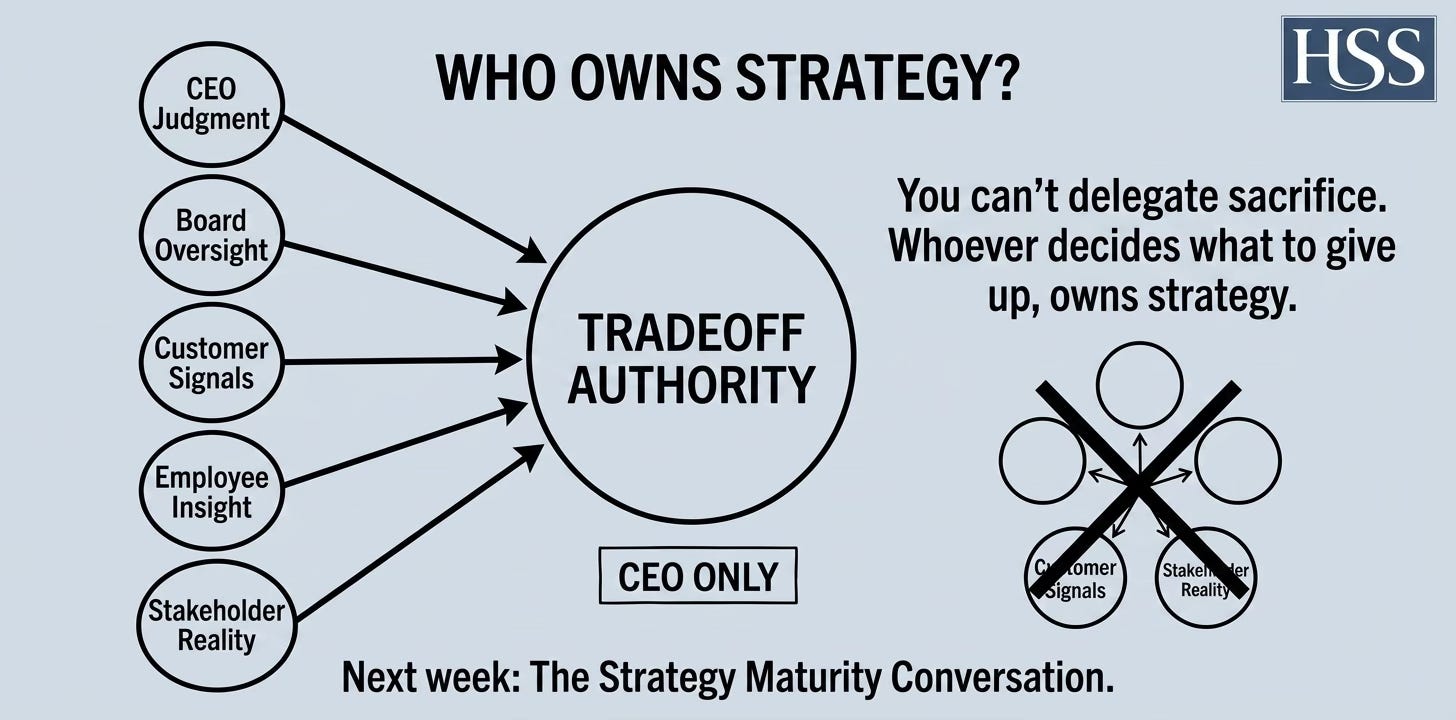
THE FIVE LEGITIMATE INPUTS
Effective strategy draws from five sources. This isn’t a soft, collaborative-process statement. It’s operationally true.
CEO judgment. The CEO holds the pattern across everything: what the organization can actually do, where the real risks are, what the team will and won’t execute on. That synthesis isn’t available to anyone else in the same form. A CEO who doesn’t contribute their own view to the strategy process is abdicating the most valuable thing they bring. If they don’t, what was the purpose of those sleepless nights?
Board oversight. Directors bring external perspective, cross-industry experience, and governance accountability that management can’t provide (sometimes not even see) for itself. The best boards ask the questions leadership teams aren’t asking. They’ve seen the cycle before, and from different perspectives. They know which “confident” assumptions have a history of being wrong.
Customer signals. Customers know things about their own needs and frustrations that no internal team knows. What they actually buy versus what they say they want, why they stay, and why they leave. The gap between what you believe your value proposition is and what they actually experience is where strategy often breaks down.
Employee insight. Who would have known? Frontline employees see patterns that executives don’t see. The quality problem that shows up in every third delivery. The competitor that keeps coming up in customer conversations. The workaround people use because the official process doesn’t work. This insight is usually available, but rarely reaches the strategy conversation.
Stakeholder reality. Partners, suppliers, funders, vendors, and regulators have market visibility that doesn’t show up in internal reports. A supplier who’s watching your competitors buy more aggressively. A funder whose priorities are shifting. A regulator whose posture or compliance rules are changing. These signals arrive at the edges of the organization and, if at all, are processed well below the strategy level.
The discipline is separating input from ownership. All five sources should contribute. One person has to decide. And you now know who that is.
WHAT IF OWNERSHIP GETS DISTRIBUTED
When strategy ownership gets spread across functions or shared between the CEO and the board, the result is almost always a compromise strategy. It’s human nature. And it can get worse: look up the “Abilene Paradox” for some context.
Compromise strategies are recognizable. Every major initiative survives the planning process because no one has the authority to cut something that belongs to someone else. The plan does twelve things instead of four. Resource allocation is driven by internal politics rather than clearly stated strategic priorities. The result is a document that everyone agreed to and nobody is fully accountable for.
The giveaway isn’t what’s in the plan. It’s what’s missing. Genuine tradeoffs and hard choices. The specific decisions about what the organization will not do, will not pursue, and will not invest in. If those decisions aren’t visible in the plan, the hard choices were avoided. Usually because no one had both the authority and the will to make them.
I reviewed a strategic plan for a DMV company that ran to over 40 pages. It had eight strategic priorities, all of them legitimate. None of them had been ranked. None had been traded against each other. The document described everything the organization wanted to do and nothing it had decided not to do. The board approved it unanimously (over my objections).
Eighteen months later, the organization was exhausted and behind on all eight.
A strategy that offends no one has probably committed to nothing.
THE BOARD’S SPECIFIC ROLE
Boards are more confused by this than any other constituency. Most boards believe they share ownership of strategy with management. Most CEOs believe the board approves strategy rather than owns it. Both positions are defensible, but they can lead to friction.
The cleaner framing: the board owns strategy governance, not the strategy itself. That means setting the parameters within which management operates, asking hard questions about the strategic logic, holding management accountable for results, and replacing the CEO if the strategy is consistently failing.
What it doesn’t mean: writing the strategy, making operating tradeoffs, or substituting the board’s industry and operational experience for management’s knowledge of the specific business.
Part of this stems from the board's population often being current or former executives. Sometimes it is hard to take off your executive hat and put on a governance one.
A board that tries to own strategy ends up managing. A CEO who treats the board as a rubber stamp ends up unaccountable. Neither version serves the organization.
WHAT STRATEGY SYNTHESIS REQUIRES
CEO ownership requires a specific kind of intellectual work that doesn’t have a natural home anywhere else in the organization.
It requires taking the five inputs (the financial picture, the market intelligence, the operational realities, the board’s perspective, the customer signals) and identifying a coherent pattern across them. Not averaging them and certainly not finding a position that offends the fewest people. It means finding the direction that makes the most sense given what all five sources are saying (often with conflict or ambiguity) and then making a specific choice about where to compete and how to win.
That synthesis requires access to all the inputs, the authority to override any of them, and the willingness to be accountable for the result. Only the CEO has all three.
This is also why CEO engagement in the strategy process isn’t optional. A consultant or a strategy team can assemble the inputs and structure the analysis. They can run the workshops and facilitate the Possibility Set conversations. But if the CEO isn’t in the room when the real choices get made, choices don’t get made. They get deferred until someone with actual authority shows up.
THE PRIME ENGAGEMENT
Calibrating the five inputs is harder than it sounds. Each source has a different form, a different cadence, and a different degree of reliability. CEO judgment can be distorted by proximity to issues, time pressure, and past experience. Board perspective can be shaped by industry patterns that don’t apply to this specific situation. Customer signals can be misread or selectively heard. Employee insights don’t reliably travel up the org chart. Stakeholder reality arrives unevenly and often too late.
The HSS PRIME engagement is a one-day diagnostic designed to address this. A private CEO session in the morning maps the CEO’s current read of all five inputs: where they’re confident, where they’re uncertain, and where the inputs may conflict. A leadership half-day in the afternoon tests whether the leadership team’s picture matches the CEO’s. The strategy assessment summary identifies the gaps. This is where awareness and alignment start.
The output isn’t a strategy. It’s a calibrated picture of where the strategy currently stands, which inputs are well-understood, and where the diagnosis needs more work before a direction is chosen. PRIME is often the right starting point before a SPRINT, particularly for organizations whose leadership team has different versions of the same reality.
It’s the question before the question: before we choose a direction, do we all see the same field?
YOUR MOVE THIS WEEK
A diagnostic worth running before your next strategy conversation:
Take the five inputs. For each one, ask: what is this source actually telling us right now, and how recently have we checked?
Then ask: do the five pictures cohere, or are they pointing in different directions?
If the CEO’s view of the competitive position differs significantly from what customers are saying, or if frontline employee intelligence isn’t making it into the strategy conversation at all, you’ve found the diagnostic work that needs to happen before any strategic choice will stick.
The synthesis is the CEO’s job. But you can only synthesize what you’re actually receiving.
Next week: The Strategy Maturity Conversation. A five-level framework for understanding where your organization currently is and what kind of work would actually move it forward.
ABOUT THE AUTHOR
Mark Haas is a strategy advisor to CEOs and boards of mid-market companies, with more than 30 years of experience across healthcare, defense, finance, social services, and biomedical research. He is the founder of Haas Strategy Solutions, a Certified Management Consultant, former Chair and CEO of the Institute of Management Consultants USA, and recipient of the IMC Lifetime Achievement Award. Mark also served as Ethics Officer for 20 years and holds degrees from Colgate and Harvard Universities.
Learn more about Mark | Connect on LinkedIn
Ready to build a living strategy that keeps pace with your market? Schedule a call.