
When I Started Flying, Instruments Were All I Had
I learned to fly from my father. He taught pilots in the Second World War, took our family places in small planes, and when I was thirteen, he offered to teach me. I soloed in a plane before I ever drove a car, and had my commercial pilot’s license by the time I was twenty. That early education about aircraft, air travel, navigation, and command decisions taught me something that took a long time to see clearly. What you trust in a cockpit, and how much, changes as you gain experience. Instruments matter the whole way through. Your relationship to them does not stay the same.
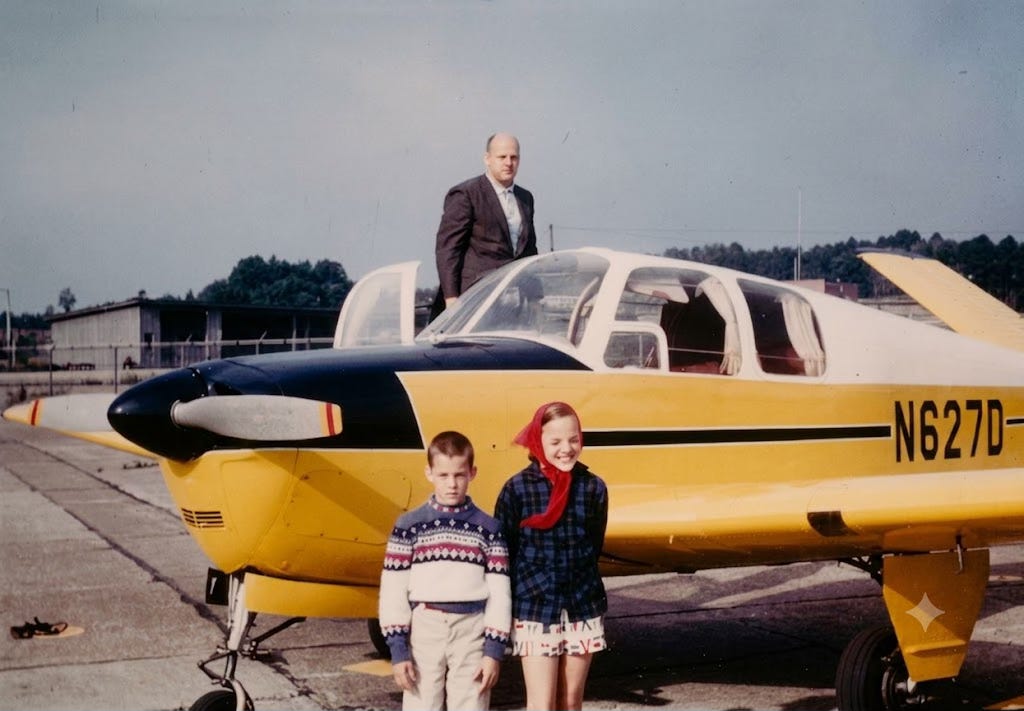
This was the day of my very first lesson (had to sit on phone books to see!)
When you start out, the instruments are all you have. You have no feel for the airplane yet, no instinct for what is normal, so you fly by the numbers because the numbers are the only thing you can trust. A student pilot stares at the panel. He has to. He hasn’t earned the right to look away. That has to change quickly to navigate safely.
WHAT EXPERIENCE ACTUALLY CHANGES
As you log hours, that does shift. You start to feel the airplane, to sense a wrong attitude before a gauge confirms it, a change in the engine before the tach shows it, and the sound of the air across the wing that hints that you should check the airspeed indicator. The feel becomes primary, and the instruments become the check, the confirmation, the second opinion. You fly the airplane by judgment, and you glance at the panel to make sure your judgment is telling you the truth. The balance shifts over the years from instruments-first to judgment-first. But it never becomes judgment-only, because a good pilot knows his senses can lie.
That is the part beginners never guess. The dangerous condition is rarely the instruments failing. It is weather, when the world outside the window turns white, and your own body starts telling you things that are not true. Your inner ear says you’re level even during a slow turn. It tells you to climb when you’re fine. In a cloud, feeling is not just useless, it’s a liar. And that is exactly when you have to trust the instruments over every instinct screaming at you to do the opposite. Learning when to trust takes years. Most of an instrument rating is an instructor covering your view and trying to fool you on purpose, until believing the panel over your gut becomes something you can actually do while afraid.
The experienced pilot isn’t choosing between feel and instruments. He’s running both and reading the panel well enough to see trouble coming before a beginner would feel it at all.
So the goal is not to graduate from the instruments. The goal is to develop real feel, back it with a disciplined scan of the panel, and get experienced enough to read what the instruments are telling you before the story is obvious, weather building, traffic converging, a system drifting out of range. Anticipation is the skill. It only comes from experience and from deliberately flying in different conditions instead of the same easy circuit over and over.
THE PLAN IS NOT THE FLYING
Now put a flight plan in that picture. A plan is a route worked out on the ground, under assumed conditions. Good work, worth doing. But here is where it goes wrong in both airplanes and companies. Too often, a strategic plan is built by a couple of people, handed to everyone else, and never really understood by the person who has to “fly” it. If you didn’t help build it and if nobody explained what it means or why, you’re holding paper you can read but can’t implement or adapt. And initial conditions never hold still. The business acronym VUCA stands for volatile, uncertain, complex, and ambiguous. It’s a fancy way of saying the weather always changes and the plan always assumed it wouldn’t.
When conditions shift, the borrowed plan is worthless, because reading a plan is not the same as understanding it, and understanding it is not the same as being able to fly the airplane. What carries you through is the same thing it is in a cockpit: feel earned through experience, instruments checked often enough to catch what your senses miss, and a clear hold on where you are and where you meant to go. The plan gets you started. The flying is everything after. Strategy follows the same principles.
My father died in 2021, at 100 years old. We bonded over aviation, trading airplane pictures and terrible flying jokes right to the end. He gave me a great deal of insight about strategy from flying without meaning to. The best was the habit he drilled into a thirteen-year-old who thought he was just learning to fly. Know where you are. Trust what you’ve learned to read. Then decide.
ABOUT THE AUTHOR
Mark Haas is a strategy advisor to CEOs and boards of mid-market companies, with more than 30 years of experience across healthcare, defense, finance, social services, and biomedical research. He is the founder of Haas Strategy Solutions, a Certified Management Consultant, former Chair and CEO of the Institute of Management Consultants USA, and recipient of the IMC Lifetime Achievement Award. Mark also served as Ethics Officer for 20 years and holds degrees from Colgate and Harvard Universities.
Learn more: haasstrategy.com/about-mark · Connect: linkedin.com/in/markrhaas · Ready to build a living strategy that keeps pace with your market? Schedule a call: calendly.com/mhaas-hss/hss-strategy-fit-conversation