
What Skydiving Taught Me About Preparation
The Instructor Said I Only Needed Three Things. He Was Right. Until He Was Wrong.
My wife had one condition before we started a family.
Get the “adventurous” (i.e., dangerous) stuff out of your system first.
One Saturday morning, I drove out to a small airfield before dawn with three friends. I was going to jump out of a perfectly good airplane.
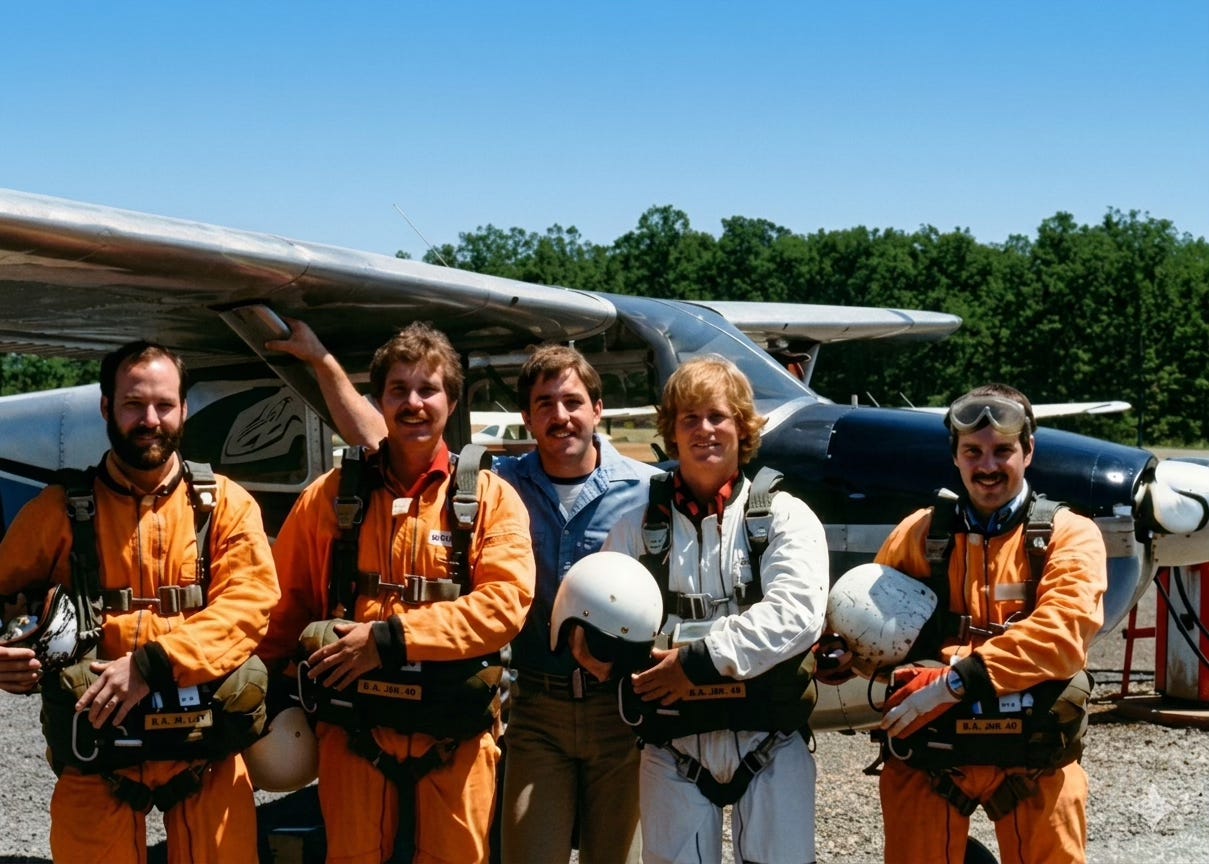
FOUR HOURS ON THE GROUND
The training took most of the morning. We packed parachutes. We practiced body position. We jumped off a platform and rolled on the ground, over and over, until it felt automatic. We covered emergency procedures for scenarios none of us expected to actually face.
By the time we walked toward the plane, I had consumed more information about skydiving than I had about most things I do regularly. (That’s me on the left)
I was not particularly nervous. I have a commercial pilot’s license, and I recognized the aircraft. That helped. My three friends were quieter than usual.
Before we boarded, the instructor gathered us on the tarmac. The engine was running. He had to shout to be heard.
“You are so anxious that you have forgotten everything from this morning. Just remember three things: push back from the plane, arch your back, and smile.”
I remember thinking: why did I get up before dark and spend four hours learning all this if three things were the whole answer?
THE JUMP THAT WENT SIDEWAYS
Nobody wanted to go first. I volunteered.
What I did not know: the wind had nearly stopped between takeoff and jump time. That moved my exit point farther from the airport than planned.
I did everything right. I pushed back from the plane. I arched. I smiled, more or less.
It was not enough. I came down short of the landing zone and settled into a line of trees at the field’s edge. I ended up suspended about 6 feet off the ground, my chute tangled in the branches above me.
And here is where the morning’s four hours came back to me.
Somewhere in the training, an instructor had said: if you land in trees, one hand covers your face, the other protects your groin. It had seemed like a footnote at the time. A contingency nobody actually expected to use.
I used it. The branches did exactly what branches do. The preparation did exactly what preparation is supposed to do.
I landed shaken but unscratched. When the instructor asked where my chute was, I pointed to the line of trees where I had left it hanging in the trees.
THE LESSON THAT STAYED WITH ME
Standing at the edge of that field, picking pine needles out of various places, I thought about what had just happened.
On the way up, the instructor’s three-item rubric had seemed like the whole story. Push back, arch, smile. Simple. Elegant. Sufficient.
Then conditions changed. The wind quit. The landing zone moved. And suddenly, the contingency training, the scenarios we had rehearsed but did not expect to need, was the only thing standing between me and a bad outcome.
Preparation looks unnecessary right up until the moment it is not.
This is not a metaphor I had to stretch to reach strategy work. It is exactly the same dynamic.
When a leadership team builds a problem statement, runs a Possibility Set, and names their priority uncertainties, most of that work will not feel necessary in the moment. The obvious path will look clear. Option A seems fine. Contingency scenarios feel like overhead.
Until conditions change. A competitor moves. A key client leaves. A regulation shifts. A cost assumption turns out to be wrong. Technology evolves.
Teams prepared are not surprised. They recognize the situation. They have already thought through it, at least partially. They respond faster and with more discipline than the teams that skipped the diagnostic work because everything looked fine on a clear day.
The instructor was right. Three things were enough for the jump itself.
He was also right about everything else he taught us.
Both of those things were true at the same time.
Next week: What Would Have to Be True? The core logic test that separates wishful strategy from testable strategy. Tuesday, 10:15 am.
Mark, Great teaching moment!. Didn't know you had a pilot's license. One of my clients was the owner/ operator of a flight school. We should chat about how 'standard" pricing structures can be changed even in a business like that.
Well said (from life's experiences) Preparation looks unnecessary right up until the moment it is not. Remindful of what I say about strategic planning: The purpose of strategic planning is not to plan for the future, but to have a future to plan for. Thought I'd share.