
What an Ecosystem Taught Me About Strategy
The Metaphor Your Leadership Team Is Missing
I start most strategy engagements with a strange question.
I ask each member of the leadership team, separately, to tell me what metaphor they use for their company. Not what the company does. How they picture it in their minds.
The answers vary wildly. And that variation tells me more than any financial statement.
The Metaphor Exercise
One executive says the company is a machine. Inputs, outputs, efficiency. If something breaks, you fix the part.
Another says it is a family. Loyalty, relationships, taking care of each other. Conflict feels like betrayal.
A third says it is a war. Competitors are enemies. Market share is territory. Victory means someone else loses.
A fourth says it is a work of art. The product is an expression. Quality matters more than scale. Compromise is failure.
These are not wrong answers. They are revealing answers. Each metaphor shapes how that person thinks about problems, priorities, and tradeoffs.
The machine person wants to optimize. The family person wants harmony. The war person wants to win. The artist wants to create.
When a leadership team holds different metaphors, they talk past each other. They use the same words but mean different things. They disagree about decisions without understanding why.
What the Variation Reveals
The first thing the exercise shows is alignment, or its absence.
If six executives give six different metaphors, they are not on the same page. They have not agreed on what kind of organization they are running. Their strategic debates are really metaphor debates, and nobody knows it.
This is useful information. Before you can choose strategy, you need a shared picture of what you are.
The Metaphor I Push Toward
After I hear their answers, I push the team toward a different frame.
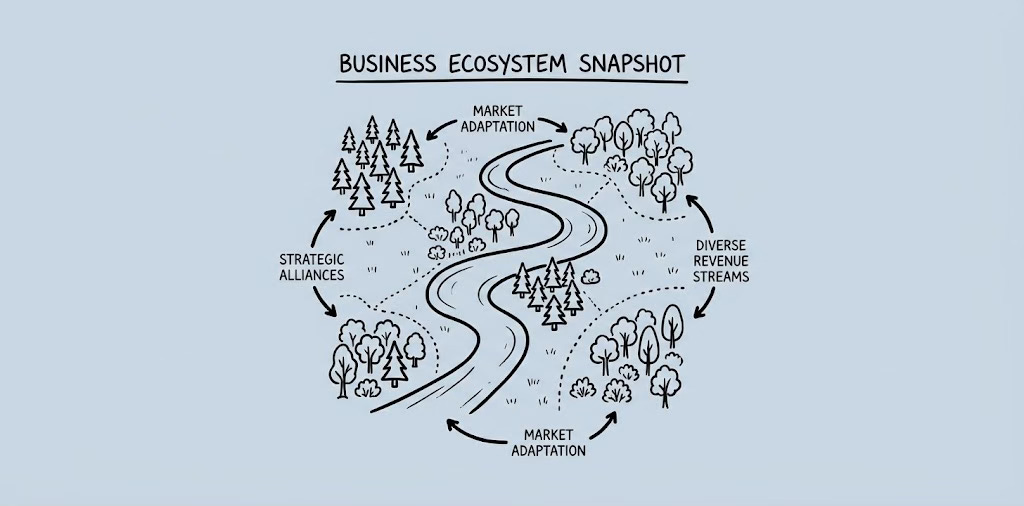
Think of your company as a population. A species. You have individuals within the company, each a little different, each contributing something. You exist within an economic ecosystem alongside other populations: customers, suppliers, competitors, and regulators.
In an ecosystem, you need both cooperation and competition. You cooperate with some species, compete with others. Sometimes you do both with the same player. The boundaries shift.
The goal is not to win a war. Wars end. The goal is not to optimize a machine. Machines become obsolete. The goal is not to preserve a family. Families can become insular.
The goal is to survive and expand. To adapt as conditions change. To find niches where you can thrive. To build the capacity to keep adapting when the next shift comes.
Why This Metaphor Works
The population metaphor does several things.
It makes variation a strength. A healthy population has diversity. Different individuals, different capabilities, different perspectives. When the environment shifts, some variants are better suited than others. The population adapts.
It makes competition normal. Ecosystems have competition. It is not personal. It is structural. You do not hate your competitors. You outcompete them or find a different niche.
It makes the time horizon long. Species think in generations. They do not optimize for this quarter. They build reproductive capacity, resilience, and adaptability. Short-term sacrifice for long-term survival is natural.
It makes sensing essential. Species that do not notice environmental changes go extinct. Populations that sense and respond quickly survive. Continuous awareness is not optional.
The Connection to Strategy
Every tool I use with clients connects to this frame.
The Weekly Assumption Scan is sensing. You monitor the environment for shifts.
The Possibility Set is diversity. You maintain strategic options like genetic variation.
The Strategy Arcade is stress testing. You simulate environmental shocks before they arrive.
Continuous governance is adaptation. You keep adjusting as conditions change.
I learned to see systems this way in forests and wetlands, studying actual populations. The logic transfers. Companies are not machines. They are living systems competing to survive.
Once a leadership team shares that metaphor, strategy conversations change. They stop arguing about whether to optimize or harmonize. They start asking: what does survival require?