
Thirty Days to Know What You Think. Four Months to Know If You're Right
Test Strategic Assumptions Against Reality Before You Commit Real Resources

THE DISTINCTION THAT MATTERS
SPRINT delivers clarity. BUILD delivers confidence. Those are different approaches, and the difference matters when the stakes are high.
Clarity means the leadership team has agreed on the actual problem, built genuine options, tested the logic with WWHTBT, named the priority uncertainties, and produced a one-page CEO Summary they’ll stand behind. That’s real value and more than most organizations produce from planning processes twice as long.
Confidence is the necessary next step to a competent strategy. It means the strategic choices have been tested against reality. Customers have been asked. Partners have been probed. The assumptions that SPRINT named as uncertain have been checked against what the world actually says. The strategy has survived a stress test designed to break it.
Clarity tells you what you think. Confidence tells you whether what you expect will hold up.
Note the image above is P.T. Barnum’s marching 21 elephants across the Brooklyn Bridge in New York City in 1884 in response to the public’s concern that it wasn’t safe. Clarity was that the best engineers designed the newly constructed bridge. Confidence only came when it was tested by showing it wouldn’t collapse.
SPRINT gives you a map. BUILD tests whether your strategy can actually carry you forward before you bet the company.
THE MOVE IS NOT AUTOMATIC
Not every organization that completes SPRINT should move to BUILD. Some should, and some shouldn’t. The decision depends on one thing: the size of the bet.
Small adjustments to a working strategy don’t need four months of validation. If your team is clear on a modest change in direction, a refined customer segment, a repositioned service, or a pricing adjustment, SPRINT is probably enough. The priority uncertainties are real but not sufficiently load-bearing to warrant the time and investment required for a full BUILD.
When you have large commitments, the strategy requirements change. Consider an acquisition, a new market entry, a platform investment, a major restructuring, or even a board commitment that locks in resources for two years. In these situations, the cost of being wrong is high enough that clarity alone isn’t sufficient. You need to know whether the assumptions you’re betting on are actually true. This is where a lot of companies don’t spend time or attention.
Whether BUILD is warranted isn’t ‘do we have priority uncertainties?’ because every strategy does. The question is: if our priority uncertainties prove wrong, what does that cost us?
If the answer is manageable, SPRINT is sufficient. If the answer is very expensive or very difficult to reverse, BUILD is worth it.
Clarity is the starting point. Confidence is what you need before an irreversible commitment.
SPRINT VS BUILD AT A GLANCE
The two engagements are designed for different situations and produce different kinds of output.
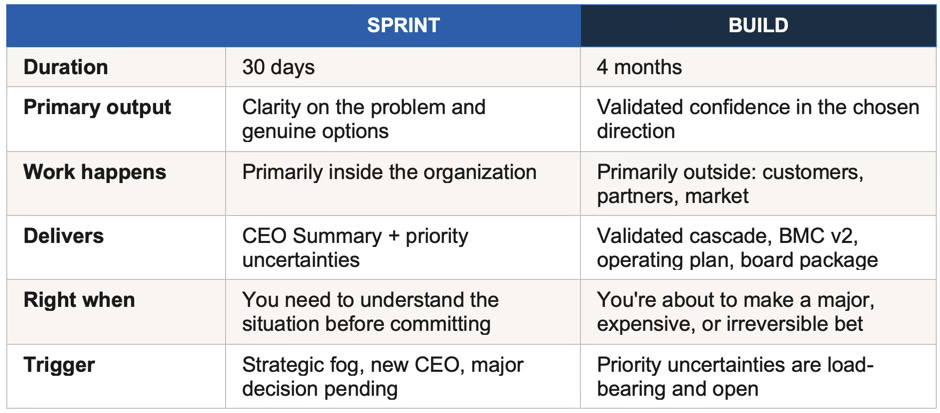
The table makes the difference concrete. Sprint is internal diagnostic work. Build is external validation. Sprint names the uncertainties. Build closes them.
THE TRIGGER: PRIORITY UNCERTAINTIES
In the April 28 post, I covered how to identify priority uncertainties (assumptions that are both high-stakes and low-confidence). Together, those two dimensions define the cases where BUILD is necessary.
High-stakes means the strategy fails big time, not just underperforms, if the assumption turns out to be false. Low-confidence means you’re essentially hoping rather than knowing it.
When SPRINT produces a CEO Summary with two or three priority uncertainties in that category, and the organization is about to act on the strategy those uncertainties underpin, the case for BUILD is straightforward. You’ve named what you don’t know. BUILD is the process of finding out.
When SPRINT produces priority uncertainties that are consequential but can be investigated through quick conversations or a small pilot, that investigation can proceed without a formal BUILD engagement. The leadership team does the work, checks the assumptions, and proceeds (with appropriate humility) about what’s still open.
The line between those two cases is a matter of judgment, but the frame is clear. It’s about the “what if we’re wrong?” and whether the fastest credible answer requires four months of structured external work or something less.
WHAT BUILD ACTUALLY INVOLVES
Four months is not arbitrary. Genuine validation of strategic assumptions can’t be compressed much further without sacrificing the quality of the evidence.
You need enough conversations with enough different people, including people whose incentives lead them to tell you things you don’t want to hear, to distinguish real signal from noise. A customer who says your value proposition is strong because they want to keep you happy is not the same as a customer who says it because they’ve compared you to alternatives and you came out ahead. Getting to the second kind of insight takes time and discipline.
BUILD works in roughly three phases. The first month maps the as-is strategy and completes the current-state cascade, often surfacing things SPRINT didn’t have time to examine in depth. The second and third months are external: customer interviews, partner conversations, competitive analysis, market intelligence. The fourth month synthesizes what was learned into the deliverables: the future-state cascade, the validated business model canvas, the 12-month operating plan, and the board-ready package.
Note that the deliverables, per se, aren’t the point. The confidence behind them is. A leadership team that has done BUILD can point to specific evidence for each strategic choice. That’s a different posture than ‘we believe (hope) this is right.’
A CASE THAT ILLUSTRATES THE DISTINCTION
A healthcare services company in Northern Virginia completed Sprint with a clear CEO Summary. The strategic choice: expand from their current mid-Atlantic market into the Northeast over the next 3 years.
Their priority uncertainties included two critical assumptions. First, that the regulatory environments in their target states would allow their operating model without material modification. Second, that their primary referral relationships, built over ten years in the DMV, would transfer to a new geography through their existing partner network.
Both assumptions were plausible but neither had been tested. The expansion would require a $4-5M capital commitment and years of focused management attention.
They moved to BUILD. The regulatory analysis in month one revealed that two of their four target states required operating modifications that would reduce margin by roughly 15-20 percent. The partner network conversations in month two revealed that their referral relationships were more personal than institutional ones and wouldn’t transfer automatically.
The expansion still happened. But not in the original four-state configuration, and not on the original timeline. The capital commitment was reconfigured, margin assumptions were adjusted, and partner strategy was rebuilt around different assumptions.
That reconfiguration cost them four months and the Build engagement fee. The alternative was to commit $4+M based on assumptions nobody had checked.
BUILD won’t tell you the answer, but it will tell you whether your strategy is actually feasible.
YOUR MOVE THIS WEEK
If you’ve completed SPRINT, or if your organization is sitting on a strategic direction without having done SPRINT, look at your priority uncertainties.
For each one, ask two questions. First, what does it cost if this assumption is wrong? Not in general, but in dollars, months, or reversibility. Second, what’s the fastest credible way to reduce this uncertainty? What has to change, and who is accountable?
If the first answer is large and the second answer is ‘it would take structured external research,’ you’re describing a BUILD situation.
If the first answer is manageable and the second answer is ‘a few conversations and a pilot,’ SPRINT is sufficient. Have the conversations, do the pilot, and expect a little humility.
The goal isn’t to do BUILD for its own sake. It’s to commit resources in proportion to how well you understand the situation. That calibration is the whole point.
Next week: A personal piece. The year I spent traveling the world gave me a different picture of how organizations think about time, risk, and what planning is actually for.
ABOUT THE AUTHOR
Mark Haas is a strategy advisor to CEOs and boards of mid-market companies, with more than 30 years of experience across healthcare, defense, finance, social services, and biomedical research. He is the founder of Haas Strategy Solutions, a Certified Management Consultant, former Chair and CEO of the Institute of Management Consultants USA, and recipient of the IMC Lifetime Achievement Award. Mark also served as Ethics Officer for 20 years and holds degrees from Colgate and Harvard Universities.
Learn more about Mark | Connect on LinkedIn
Ready to build a living strategy that keeps pace with your market? Schedule a call.