
The World Economic Forum Says Strategy Has Changed. One Thing Hasn't.
If You Can't Pass This Five Question Test, You LIkely Dont Have A Strategy
THIS IS NOT YOUR FATHER’S STRATEGY
The World Economic Forum published a piece in March on how corporate strategy is changing. The headline argument was about volatility, AI, geopolitics, and why strategy has never been harder. It is worth at least a scan if not a full read (link to article).
But buried in the middle was a sentence worth keeping: “Some things have not changed. CEOs are still making fundamental choices: where to play and how to win.”
That’s an important distinction. It points to something that many organizations get wrong: they accept the vocabulary without doing the work those words require. They write down a where-to-play and a how-to-win. They think they are done. Then they wonder why the strategy doesn’t hold. It’s because it isn’t a full strategy.

The above image is the point. Of five points of view, two might be clear, but three others are a bit fuzzy and may be seriously misaligned. You don’t know until you explore fully and ensure all fice points of view are internally consistent.
Roger Martin’s concept of the strategy cascade, developed through his work at P&G and formalized in Playing to Win, provides one structured way to answer that question. It has five levels, from winning aspiration down to management systems. Each level answers a specific question. Each has to be consistent with the others.
It isn’t a template. It’s a logic test. And the five levels have to pass the test together, not separately. This is also not a binder of prose but a one or two-sheet summary of key decisions that are internally consistent.
A strategy is not the sum of five good answers. It’s five answers that are consistent with each other.
WHAT THE CASCADE IS
The five levels form a connected argument about how the organization intends to succeed.
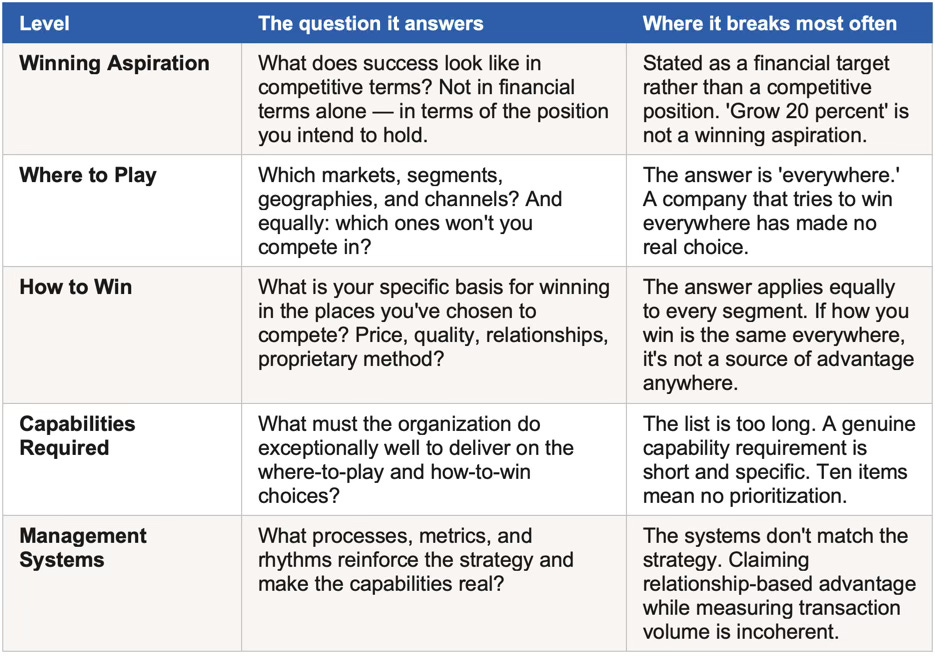
This isn’t a planning tool. It’s a coherence test. When you write out and read the five answers as a connected argument, the inconsistencies become visible. Note: they’re almost always there.
THE COHERENCE TEST
Most strategy documents fail this test in one of two places.
The first is where-to-play and how-to-win. The aspiration sounds compelling. The markets are identified. But the competitive basis, the how-to-win, is generic and applies equally to every segment listed. “Superior customer service” and “innovative solutions” are not how-to-win statements. They’re marketing language. A real how-to-win is specific enough that it wouldn’t apply to a competitor in the same segment.
The second failure is between capabilities required and management systems. For example, your strategy says deep relationships are your competitive basis. The management systems measure transactions, track volume, and reward new account acquisition. Those systems are therefore perfectly designed to undermine the stated strategy. Nobody decided to do that. It was just a continuation of existing systems.
Running the cascade as a coherence test surfaces both problems. That’s not the same as solving them. But you can’t solve a problem that hasn’t been named yet.
What you measure is what you manage. If the metrics don’t match the strategy, the metrics win every time.
CURRENT STATE VERSUS FUTURE STATE
In a SPRINT engagement with HSS, the team produces a current-state cascade. Not the strategy as written, but the strategy as practiced. What does the resource allocation actually say about where we’re competing? What does customer behavior actually reveal about how we win, or fail to win? If you read that statement to them, would they say that it was unambiguously about you?
That version is usually uncomfortable. The current-state cascade makes visible the gap between what the organization says it’s doing and what it’s actually doing. A company that claims to compete on premium quality but prices its goods and services at market rate and operates with a commodity cost structure is not executing a premium strategy, whatever the mission statement says.
BUILD produces the future-state cascade. The direction chosen through the Possibility Set and validated through stakeholder research is translated into all five cascade levels. Where specifically will the organization compete? On what specific basis? For what must it genuinely be excellent? What management systems will make those capabilities real rather than aspirational?
The gap between the two cascades is the strategy work. It defines what has to change, at every level, to move from where you are to where you’ve decided to go. And, most importantly, what you are willing to give up.
WHY THE BOTTOM TWO LEVELS GET SKIPPED
Capabilities required and management systems are the least glamorous levels of the cascade. They’re also where strategy goes to die.
Leadership teams spend real energy on winning aspiration and where-to-play. Those conversations are engaging. They’re about possibility and ambition. They are also about factors that don’t consume budget and talent. Get those wrong and no heads roll (well, maybe the CEO’s).
Capabilities required is harder because it forces honesty about what the organization actually does well versus what it wishes it did well. Most organizations have a significant gap between stated capabilities and real capabilities. Writing it out makes that gap visible in a way that’s difficult to ignore. And the cost to get those capabilities.
Management systems is hardest of all because it’s the most operational and the most politically charged. Changing how the organization measures and rewards behavior is not a strategic decision in the abstract. It affects specific people’s jobs, incentives, and status. That’s why it tends to get deferred, discussed, and eventually not done.
A cascade that’s complete through how-to-win and vague on capabilities and systems is a cascade that describes aspiration, not strategy. Roger Martin made this point about P&G’s early strategy work: the first three levels were clear but the bottom two were weak. The strategy didn’t hold until all five were developed with equal rigor.
THE DMV CONTEXT
For organizations in the DC region, this matters in a specific way. The federal contracting market is competitive on price and relationships simultaneously, which creates an inherent tension in any where-to-play and how-to-win combination. A firm that tries to win on both axes in the same segment will find its capabilities requirements are contradictory and its management systems can’t serve both masters.
The cascade makes that tension explicit. Which is the real basis for winning here? The answer has operational consequences that run all the way down to how the firm hires, how it prices, and how it measures success.
YOUR MOVE THIS WEEK
Write out your draft As-Is cascade. Start with the winning aspiration, then work through where to play, how to win, capabilities required, and management systems. Don’t stop at the first pass.
The cascade is an iterative, recursive process. Once you’ve drafted all five levels, read them as a connected argument. Does the how-to-win follow logically from where you’ve chosen to compete? Do the capabilities required actually produce the competitive advantage you’ve claimed? Do the management systems support those capabilities or quietly undermine them? Will the whole system deliver on your winning aspiration? Is this strategy unique to your organization?
Where the answers conflict, revise and run through again. Keep cycling through the five questions until they’re internally consistent. Even if they answer all five questions, most organizations stop after one pass. That’s why most cascades describe aspiration rather than strategy.
Now for the real test. Give the cascade to a few trusted advisors, investors, customers, or partners and ask if this accurately reflects your organization. Then ask informally if it meets their needs as a key stakeholder. The disconnects are a strong input to your To-Be cascade.
The discipline isn’t finishing the cascade. It’s finishing a cascade where all five levels reinforce each other, and it makes sense to those affected by it.
Next week: Testing Assumptions with Real Stakeholders. Once you have a future-state cascade, the question is whether the underlying assumptions actually hold. That’s the work BUILD is designed to do.
ABOUT THE AUTHOR
Mark Haas is a strategy advisor to CEOs and boards of mid-market companies, with more than 30 years of experience across healthcare, defense, finance, social services, and biomedical research. He is the founder of Haas Strategy Solutions, a Certified Management Consultant, former Chair and CEO of the Institute of Management Consultants USA, and recipient of the IMC Lifetime Achievement Award. Mark also served as Ethics Officer for 20 years and holds degrees from Colgate and Harvard Universities.
Learn more about Mark | Connect on LinkedIn
Ready to build a living strategy that keeps pace with your market? Schedule a call.