
The One-Page CEO Summary
Why Strategy That Can't Fit on One Page Isn't Clear Enough Yet
The One-Page CEO Summary
Reading time: 5 minutes
THE SHORT VERSION
Over the past six weeks, we’ve worked through the full Sprint sequence.
You’ve named the actual problem instead of the symptom. You’ve built genuine options instead of defaulting to Option A. You’ve run WWHTBT to test the logic. You’ve identified the assumptions with high stakes and low confidence.
Now what?
You put it on one page.
Not because brevity is a virtue in itself. Because if the strategy can’t fit on one page, the choices haven’t been made yet. Fuzzy thinking expands to fill whatever space you give it. One page means you made the hard calls.
A 40-slide strategy deck isn’t evidence of rigor. It’s evidence that nobody decided what mattered most.
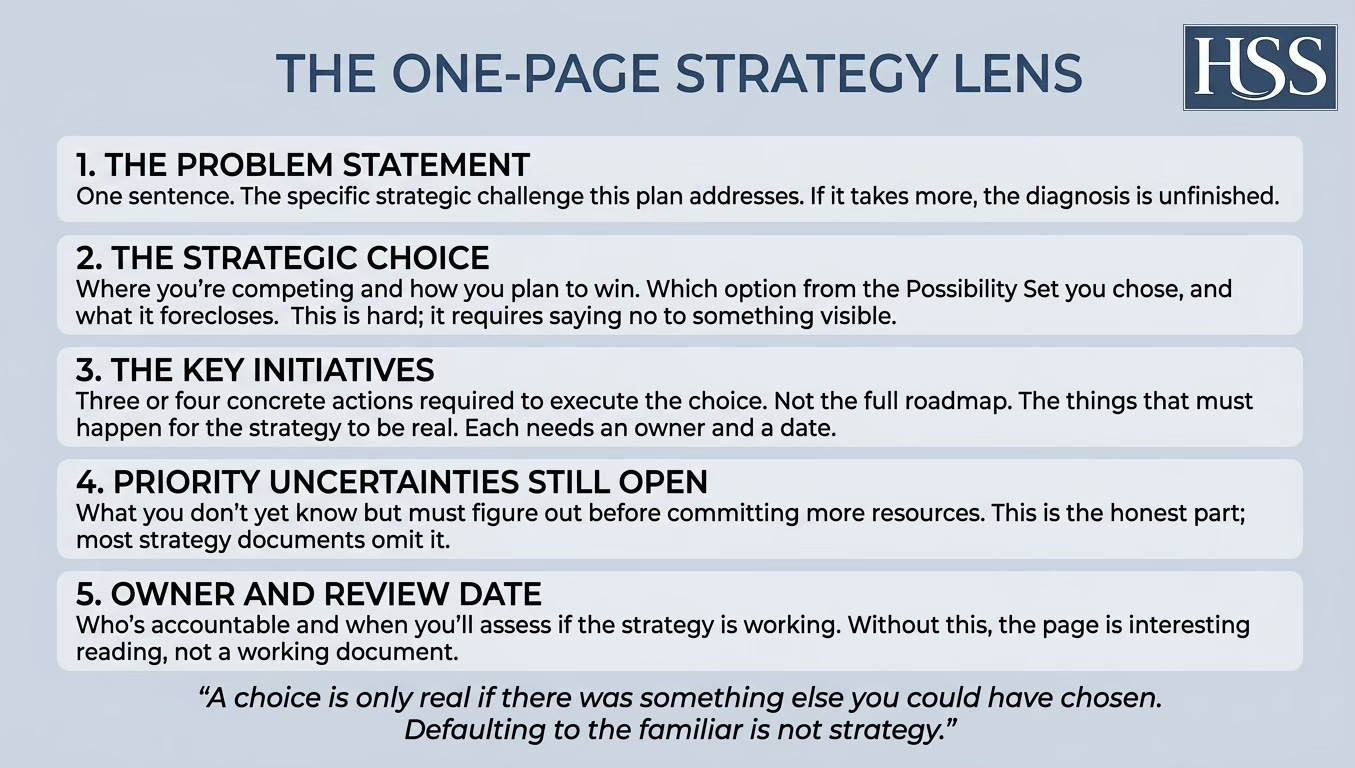
WHAT GOES ON THE PAGE
The CEO Summary has five elements. Not sections, not chapters. Five things, all on one page.
1. THE PROBLEM STATEMENT
One sentence. The specific strategic challenge this plan is designed to address. If it takes more than one sentence, the diagnosis isn’t finished. It’s OK to redraft this a few times. Maybe write a paragraph and chop away.
2. THE STRATEGIC CHOICE
Where you’re competing and how you plan to win. Which option from the Possibility Set did you choose, and what does that choice foreclose? This is the hardest element to write because it requires saying no to something visible. Who likes to say no?
3. THE KEY INITIATIVES
Three or four concrete actions required to execute the choice. Not the full roadmap. The things that have to happen for the strategy to be real. Each needs an owner and a date. These are things where absence or underperformance is existential.
4. PRIORITY UNCERTAINTIES STILL OPEN
What you don’t yet know but must figure out before committing the next level of resources. This is the honest part of the page. Most strategy documents omit it entirely. Turn assumptions that everyone thinks are facts back into assumptions with uncertainties.
5. OWNER AND REVIEW DATE
Who’s accountable and when you’ll assess whether the strategy is working. Without this, the page is interesting reading. It’s not a working document.
THE TEST EACH ELEMENT PERFORMS
Every element on the page forces a discipline that the full strategy process was building toward.
The problem statement forces you to commit to a diagnosis. You can’t fit a vague description in one sentence. Either you know what the actual problem is, or you don’t. The page makes that visible immediately. It gets better with experience.
The strategic choice forces specificity about where you compete and why you expect to win there. ‘We’ll pursue growth across all segments’ doesn’t fit. That’s not a strategy either. The format demands a real answer.
Key initiatives force prioritization. You’ll have more ideas than will fit. Good. The exercise of deciding which three or four make the list is the strategy work, not a summary of it.
Priority uncertainties force honesty. Listing what you don’t know is uncomfortable. Most leadership teams skip it. Teams that include it make better decisions because everyone is working from the same picture of the risks.
Owner and review date force accountability. A strategy without a specific person responsible and a specific date for assessment is a preference, not a commitment.
THE ‘NO’ TEST
One diagnostic worth applying before you call the page done: can someone who reads it tell you specifically what your organization has decided not to do? Not Sophie’s Choice; just something(s) that is not a top priority
Real strategic choices have costs. Specific customers you won’t pursue. Market segments you’re leaving to competitors. Capabilities you’re choosing not to build because they don’t fit the direction.
If the page doesn’t describe any costs, the choices haven’t been made. You have a document about strategy rather than a document that is strategy.
A COO I worked with in Virginia had a beautifully written one-pager. Smart language, clean structure. When I asked her what market segments the company had explicitly decided not to pursue, she paused. ‘I don’t think we put that in there,’ she said.
That’s the tell. The page described aspirations. The choices were still pending.
WHO READS IT AND WHY
The CEO Summary has three audiences, and it needs to work for all three.
The leadership team. The page is the alignment artifact. Everyone should be able to read it and agree it accurately describes what they decided. If two people read it and come away with different understandings of the strategic choice, the choice wasn’t actually made.
The board. Directors don’t need the full analysis. They need to understand the strategic logic, the key risks, and what questions to ask management. A one-page summary gives them exactly that in the time it takes to read a page. A 60-slide deck gives them data and no clear point of view. More likely, they won’t bother reading it.
New executives. When someone joins the leadership team six months after the Sprint, they should be able to read the CEO Summary and understand where the organization is (and was) pointed and why. If they can’t, something about the organization’s strategy communication is broken.
WHAT THIS CLOSES
This is the sixth and final article in the Sprint sequence.
Weeks 9 (March 24) through 15 (this week) walked through every Sprint deliverable: the problem statement, the Possibility Set, the as-is strategy cascade, the WWHTBT logic test, the priority uncertainties, and now the CEO Summary. Together, they form a complete picture of what it takes to go from strategic fog to documented clarity in 6 weeks.
Some organizations stop here. They have what they need: a shared, honest picture of the situation, genuine options evaluated rather than assumed, and a one-page synthesis that the leadership team will stand behind. That’s real value. More than most organizations produce from a much longer planning process.
Others use the CEO Summary as the starting point for a Build engagement, in which priority uncertainties are investigated, and the strategy is validated against actual market feedback before making big bets. The page tells you what you’ve decided. Build tells you whether the decisions were right.
Sprint gives you clarity. Build gives you confidence. The CEO Summary is the document that connects them.
BUILD YOUR OWN THIS WEEK (I DARE YOU!)
Use the five-element structure above and give yourself 90 minutes.
Start with the problem statement. Write it in one sentence. If you find yourself reaching for a second sentence, that’s the signal the diagnosis still has work to do.
Move to the strategic choice. Write specifically where you compete and how you expect to win. Then write one sentence about what that choice forecloses.
Name three or four initiatives. Real ones, with owners attached.
List your priority uncertainties. The conditions from your WWHTBT analysis that are both high-stakes and not yet confirmed. Two or three is plenty. If you have more than that, you haven’t sorted them yet.
Add the review date. Pick a specific date, not a quarter. Specific dates produce accountability. Quarters produce drift.
When you’re done, give it the ‘no’ test. Then give it to someone outside the leadership team and ask them: What has this organization decided not to do?
Their answer will tell you whether the page is done.
Next week: A personal piece on strategic patience and what coaching youth sports taught me about the pace at which real development happens.
If you’ve been following this sequence and want to run a Sprint with a structured facilitator, the HSS Sprint engagement is built around exactly these five deliverables. Start with a Fit Call.
Well said, Mark. Simplicity can equal better focus, with strategy execution requires. I would add, from my perspective that the first step, Problem Statement, can possibly keep leadership focused on 'fixing' things or, worse yet, simply prolonging the past into the future. A stronger heading might be Possibility Statement, e.g., what is possible, what can we co-create together. That one shift in wording, for me and my clients, encourages them to look forward not backwards. Thanks for your post.