
The End of Sustainable Competitive Advantage
Why Transient Advantages Are Now the Rule
For decades, strategy was built on a simple premise: find a competitive advantage and defend it. Build barriers to entry. Create switching costs. Lock in customers. If you did this well, you could sustain your advantage for years, sometimes decades.
That model is not wrong. It is incomplete. And for many companies, it has become dangerous.
The assumption behind sustainable advantage is that markets move slowly enough for barriers to hold. But the forces that once protected advantages have weakened. Technology spreads faster. Information is harder to hoard. Competitors emerge from unexpected places. Customers switch more easily than before.
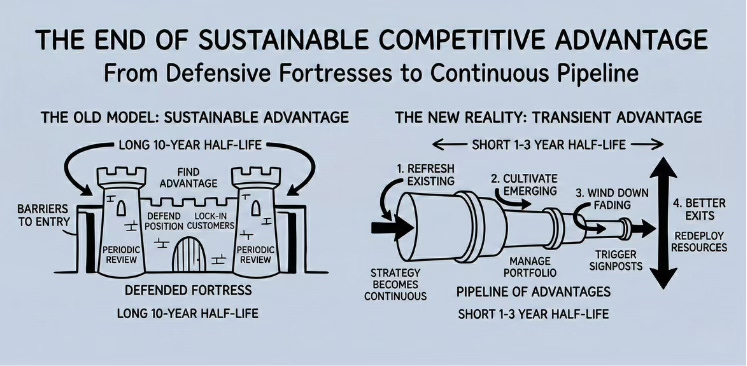
The result is that advantages have a shorter half-life. What took a decade to erode now takes three years. What took three years now takes one. Companies that build strategy around defending a single advantage often find themselves defending a position that no longer matters.
The Evidence
Rita McGrath, a professor at Columbia Business School, studied this pattern across industries. Her research found that the average time a company stays in the top quartile of profitability has declined steadily. Companies fall from industry leadership faster than they used to. The ones that sustain performance are not the ones with the strongest barriers. They are the ones that continuously build new advantages as old ones fade.
This matches what I have seen in 30 years of consulting. The companies that struggle most are often the ones that succeeded for a long time. They built a strong position, defended it well, and then watched it erode as the market shifted underneath them. Their strategy was sound. It was also static.
The companies that thrive treat advantage as temporary by design. They do not wait for an advantage to erode before building the next one. They assume every edge has an expiration date and plan accordingly.

What Transient Advantage Means
If advantages are temporary, strategy has to change in three ways.
First, strategy becomes continuous. The old model treated strategy as a periodic event. Every three to five years, you conduct a strategic review, set a new direction, and execute until the next review. In a world of transient advantage, that cycle is too slow. By the time you complete a five-year plan, the conditions that shaped it may have changed twice.
Continuous strategy does not mean constant chaos. It means building a rhythm of regular review, testing, and adjustment. Quarterly, not annually. You hold the direction steady while adjusting the specifics as conditions shift.
Second, you manage a portfolio of advantages, not a single position. Instead of betting everything on one edge, you cultivate multiple advantages at different stages. Some are mature and generating returns. Some are emerging and require investment. Some are fading and need to be wound down. The goal is a pipeline, not a fortress.
Third, you get better at exits. The hardest part of transient advantage is knowing when to stop. Leaders fall in love with the positions that built the company. They defend advantages past their expiration date, pouring resources into battles they cannot win. Strategic discipline means recognizing when an advantage has run its course and redeploying resources before returns turn negative.
The Emotional Challenge
This is harder than it sounds. Sustainable advantage is comforting. You find your edge, build your moat, and protect it. There is clarity in defense. You know what you are protecting and why.
Transient advantage is less comfortable. You build something valuable, knowing it will fade. You invest in new positions before the old ones fail, which feels like abandoning what works. You exit businesses that still make money because you see the decline coming. This requires a different emotional relationship with strategy.
I have watched CEOs struggle with this transition. They understand the logic. They see that their industry is changing faster than it used to. But when it comes time to wind down a legacy business or cannibalize a profitable product line, they hesitate. The old advantage feels real. The new one feels speculative. So they defend the old position too long and arrive late to the new one.
The companies that manage transient advantage well treat this as a discipline, not a feeling. They build triggers and signposts that tell them when an advantage is peaking, when it is declining, and when it is time to exit. They make the decision in advance, based on evidence, so they do not have to make it in the moment, based on emotion.
What This Means for Your Strategy
If you lead a company in the $5-100 million range, you are not immune to this shift. In some ways, you are more exposed. Large companies can sustain declining advantages longer because they have more resources to burn. Midsize companies feel the pressure faster.
Here is what I would ask:
How old is your current advantage? If your competitive edge is more than five years old and you have not refreshed it significantly, it may be weaker than you think. Competitors have had time to study it, copy it, or route around it.
What is your next advantage? If you cannot answer this question, your strategy is incomplete. You should be able to point to the emerging positions that will generate value when your current edge fades.
How would you know if your advantage is eroding? What signals would you see in customer behavior, pricing power, or competitive activity? If you do not have clear signposts, you may not notice the decline until it is too late to respond.
Do you have the discipline to exit? Have you ever voluntarily walked away from a profitable position because you saw decline coming? If not, you may have a bias toward defending too long.
The Shift in Mindset
Sustainable advantage asked: How do I protect what I have?
Transient advantage asks: How do I continuously build what is next?
Both questions matter. You still need to execute your current position well. But if you only ask the first question, you will eventually run out of advantage to protect.
Strategy in a world of transient advantage is not more complicated. It is more continuous. The tools are the same. The choices are the same. What changes is the rhythm. You make strategic choices more frequently, test them more regularly, and adjust them more willingly.
This is not comfortable. But it matches how markets actually work. And companies that embrace it outperform those that keep waiting for their advantage to become sustainable again.
(Hint: It won’t).