
The Alignment Illusion: Agreeing in the Room, Disagreeing in the Hallway
Alignment Isn't Agreement. It's Shared Logic on the Choices and What They Cost.
A PATTERN WORTH NAMING
Last month, a Forbes article (Where ‘Almost Alignment’ Actually Hides In Your Executive Team, July 6, 2026) described how most CEOs will recognize. Your leadership team leaves a strategy meeting nodding their heads and nominally agreeing on a clear path. Three weeks later, a couple of your leaders are running different versions of the same decision. Nobody can quite name where it diverged from the “agreement.”
The Forbes author borrowed a great phrase for this from consultant Chris Cureton: “almost alignment.” I like it because it captures something that outright disagreement doesn’t. Nobody objected. Nobody is being difficult. Everyone in the room genuinely believed they agreed.
They did agree, in a sense. They agreed on the words. The reasons are a subject for another article, but they include the Abilene Paradox, cognitive biases, and other human social practices.
Alignment isn’t agreement. What’s missingg is shared logic about the choices and what those choices cost.
HOW FOUR PEOPLE HEAR THE SAME SENTENCE
Imagine your leadership team commits to focusing on mid-market customers. Everyone nods. It’s a reasonable direction, and nobody has a reason to fight it.
The head of sales understands that to mean pursuing every opportunity in that revenue band (a volume strategy). The head of operations hears the same sentence and understands it as permission to standardize delivery around the typical mid-market client (an efficiency strategy). The CFO hears it as a margin discipline instruction, meaning decline the low-margin mid-market work. The head of marketing hears a brand repositioning. You have your own idea of what the agreement meant.
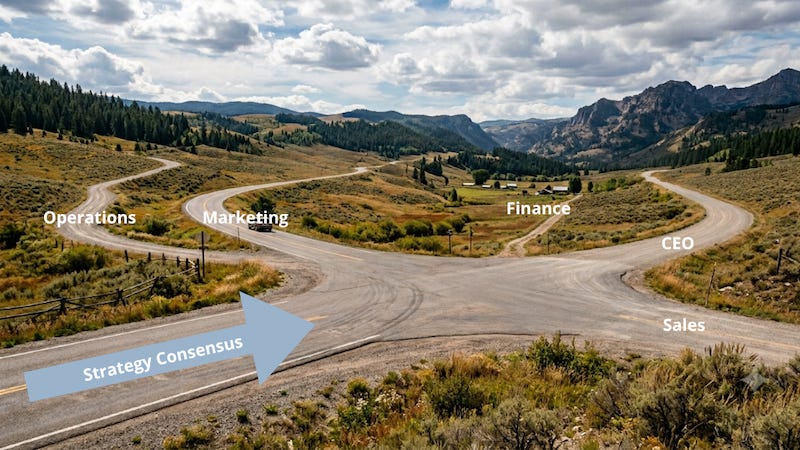
None of them are wrong. All four readings are consistent with what was actually said or, more accurately, what was heard. And all four are in direct conflict with each other across dozens of decisions that will come up in the next quarter. No one escalated any of them because, from where each person sits, they’re executing the strategy they thought everyone agreed to.
Six months later, you are looking at execution problems and wondering why a team this capable can’t seem to move in a unified direction. It isn’t an execution problem. It’s an alignment problem that was invisible when it was created.
WHERE IT ACTUALLY BREAKS
The Forbes piece is pretty clear about the two failure points, and my experience matches it.
The first is trade-offs. Your team agreed on strategic intent but never named what the intent costs, whether time, budget, or opportunity costs. Focusing on mid-market means someone may have to give up something: a segment, a service line, a customer relationship they spent three years building. Until that cost is named out loud, in the room, with the person who bears it as part of the conversation, the decision hasn’t been made. You “announced” it and assumed everyone was OK with it.
The second is decision rights. Even teams that name the trade-offs often stop before assigning who decides what going forward. When the next ambiguous case arrives (it always does), whoever owns the closest function decides according to their own reading. That’s not insubordination. That’s what happens when nobody set rules for how trade-offs will be made.
Both failures share a root cause. The conversation ended when the room felt comfortable rather than when the work was finished.
WHY MEETINGS PRODUCE FALSE COMFORT
Large group settings are famously bad at surfacing disagreement. There is a right size: too small can lack perspective, too large can lack ownership.
People manage their reactions. They defer to the apparent direction of the room. They tell themselves the concern is no big deal, or that they’ll raise it later in a smaller (safer) setting, or that they’re probably the only one who sees it. Some stay quiet because slowing the room down carries a social cost and being the person who objects twice in a quarter could brand you as obstructionist.
Then the meeting ends and the real conversations start in the hallway, in the parking lot, and in the one-on-one the next morning. That’s where the disagreements go. They don’t disappear, just stop being visible to the people who most need to see them.
A CEO of a $20M company described this to me as the worst part of the job. Not the hard decisions. The decisions that felt easy in the room and turned out not to have been decided at all. No one was being deceptive, just being human and avoiding conflict.
WHAT REAL ALIGNMENT REQUIRES
Three things have to happen, and none of them happen naturally.
Each leader has to state to each executive member what the strategy requires of their separate function. Not what they’d like to do, but what the company direction obligates them to do differently. The gap between those two statements, when spoken out loud, is where most of the misalignment lives. It can be fixed.
The trade-offs have to be named specifically. Which initiative won’t survive the resource constraint? Which customers will get a different level of service? Whose priority gets downgraded or won’t make the cut? When those answers are given in the room instead of discovered in execution, alignment happens.
Also, the team needs an agreed protocol for the cross-functional conflicts that will inevitably arise. Which ones get resolved at the leadership level, on what basis, and who has the final call. Without that, every disagreement becomes a CEO escalation, which is exhausting for the CEO and slow for everyone else.
Agreement is what happens when nobody objects. Alignment is what happens when everyone can name what the decision costs and who bears it.
A SINGLE DAY, DELIBERATELY STRUCTURED
This work doesn’t always happen in a normal leadership meeting. The pressure of the standing agenda and the presence of operational urgency will crowd it out every time.
The PRIME engagement is built around exactly this problem. One day, three parts: a private CEO diagnostic in the morning, a leadership half-day designed to surface the fractures rather than smooth them over, and a strategy assessment summary that names what was found.
The leadership half-day is not a “team-building exercise” and it isn’t a facilitated conversation about values. It’s a working session on the specific strategic choices that require cross-functional agreement, run by someone with no stake in which answer wins. That last part matters more than it sounds. A CEO who facilitates their own alignment session is doing the hardest analytical work in the room while also managing the group dynamics. Those two jobs conflict.
Most teams find two or three tradeoff decisions they’ve been missing or deferring, some for a year or more. Naming them takes a few hours. Living with them undecided has usually taken much longer.
YOUR MOVE THIS WEEK
Pick one strategic priority your leadership team has agreed on. Ask each member independently, in writing, what fully executing it would require their function to do differently and to stop doing. Be specific about time, budget, trade-offs, responsibilities, and accountabilities.
Collect the answers confidentially. Then compare them, looking for the places where the implications conflict.
Those conflicts are already in your execution. The only question is whether you’re managing them or they’re managing you.
Next week: What Would Have to Be True. Roger Martin’s question, applied. The tool that kills bad strategy fast and gives your team something to use Monday morning.