
The Three Rituals of High Strategic Metabolism
Stop waiting for the annual planning retreat. Build your pivot capability now
Your strategy isn’t failing because it’s wrong. It’s failing because your organization digests information too slowly to act on it.
In biology, metabolism is how your body converts fuel into energy. High metabolism means efficient processing, quick adaptation to environmental changes, and fast self-repair.
In business, Strategic Metabolism is how your leadership team converts market signals into coordinated decisions. And most mid-market firms are running dangerously slow.
The Annual Planning Trap
Here’s the pattern I see in companies between $20M and $50M in revenue:
Every fall, the leadership team disappears for two days. They emerge with a strategic plan. It goes into a binder. The binder goes on a shelf. For the next eleven months, everyone executes against assumptions that were already stale by Thanksgiving. Deployment to employees? Not so much.
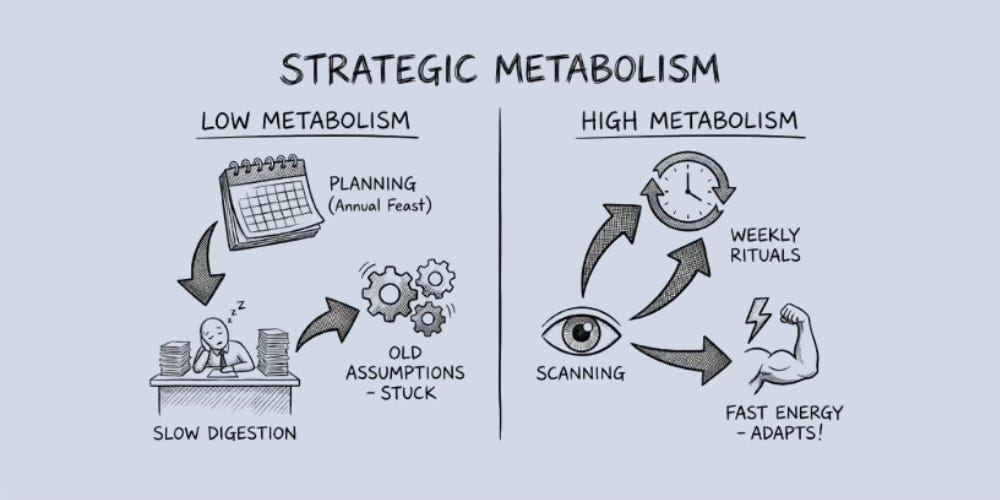
This is “Low Strategic Metabolism.” A massive annual feast followed by months of sluggish digestion. By the time the organization realizes the market has shifted, it’s too bloated with old assumptions to move. This is “Strategy Debt.”
Rita McGrath calls this the danger of treating competitive advantage as sustainable. It isn’t. Advantages erode. Customers shift. Competitors adapt. Technology moves. The companies that win aren’t the ones with the best strategy in January. They’re the ones who can update their strategy in March without calling an emergency board meeting.
What High Strategic Metabolism Looks Like
A leadership team with high strategic metabolism does three things differently:
They process new information weekly, not annually. They eliminate strategic waste quarterly. And they push decision rights down to the people closest to the data.
This isn’t about working faster. It’s about building a cadence of organizational habits that makes adaptation routine instead of heroic.
My college major was biology. I spent years studying ecosystems, feedback loops, and how organisms adapt to environmental pressure. The lesson that stuck: survival doesn’t go to the strongest or the smartest. It goes to the most responsive.
The same is true for your company.
Ritual 1: The Weekly Assumption Scan
Every strategy rests on assumptions. You assumed your biggest customer would renew. You assumed your competitor wouldn’t cut prices. You assumed the regulation wouldn’t pass until next year.
Most leadership teams never revisit these assumptions until something breaks.
The fix takes ten minutes per week. At the end of your regular leadership meeting, ask one question: “What did we learn this week that makes our strategy more or less valid?” Ask what core assumptions underlying your strategy seem to be shifting. This keeps attention on both what and why of the strategy.
Not “what happened this week.” That’s a status update. The question is narrower: what new information challenges or confirms the bets we’ve already made? That’s an Assumption Audit.
This isn’t about changing strategy every week. It’s about noticing when the ground shifts before you fall into the hole.
Write down what you learn. Review the list monthly. Patterns will emerge.
Ritual 2: The Quarterly Burn
Every organization accumulates strategic debt. Projects that made sense two years ago but now consume resources without generating results. Initiatives that nobody wants to kill because someone important sponsored them. Meetings that exist because they’ve always existed.
Good strategy requires choosing what not to do. But most leadership teams are better at adding priorities than subtracting them.
Every 90 days, schedule a two-hour session with one purpose: identify what to stop. Not pause. Stop.
The test is simple. For each active initiative, ask: “If we weren’t already doing this, would we start it today?” Be aware of the Sunk Cost Bias. If the answer is no, cut it. Redirect the resources to something that matters.
This is uncomfortable. It requires admitting that past decisions were wrong or that conditions changed. But the alternative is worse. Low-metabolism organizations die slowly, suffocated by their own accumulated commitments.
Ritual 3: Distributed Decision Rights
Here’s a question: if your market shifted by 20% tomorrow, how many layers of approval would it take for your front-line team to respond?
In most mid-market companies, the answer is “too many.” A salesperson notices a competitor undercutting on price. They escalate to their manager. The manager escalates to the VP. The VP schedules time with the CEO. By the time a decision gets made, the customer is gone.
High-metabolism organizations push decision rights down to the people closest to the information. Not every decision. Not bet-the-company choices. But the micro-pivots that compound into strategic agility.
This requires two things. First, strategic clarity across the company. If people don’t understand where you’re trying to win and how, they can’t make good judgment calls. Second, trust. You have to believe that people will make reasonable decisions even when you’re not in the room.
The CEO’s job isn’t to make every decision. It’s to build a system where good decisions happen without top-level executive involvement.
The Bottom Line
The winners of 2026 won’t be the companies with the best PowerPoint decks. They’ll be the ones who can digest a market shift on Monday and have a coordinated response by Friday.
That doesn’t require genius. It requires three rituals practiced consistently:
Scan your assumptions weekly. Burn your dead weight quarterly. Push decisions to the people with the data.
Do this for a year and you won’t recognize your organization. You’ll have built something most mid-market companies lack: a leadership team that can adapt as fast as the market demands.
Question for the week: When was the last time your leadership team killed a project that was “working fine” but no longer fit your strategy?