
Strategy vs. Strategic Planning
The Distinction That Determines Success
Most companies have a strategic plan. Fewer have a strategy. The difference determines whether the plan survives contact with reality.
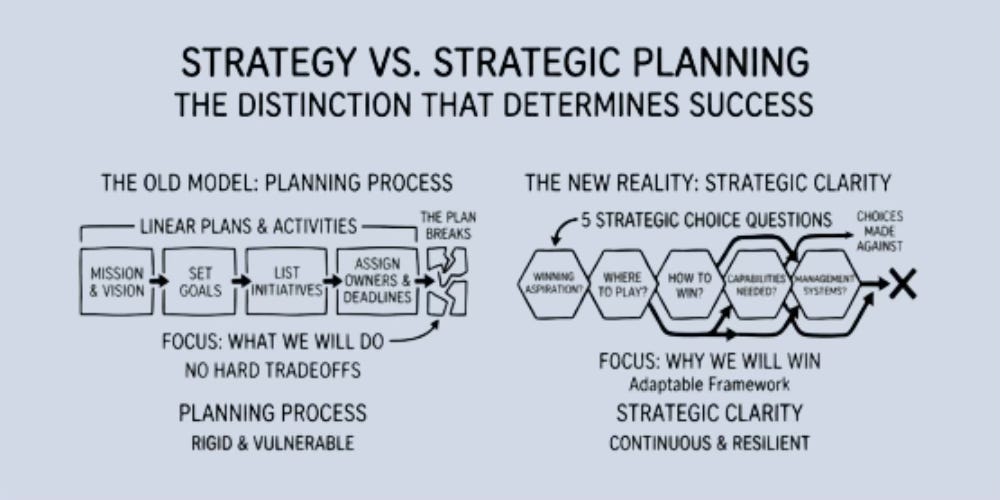
This is not wordplay. The distinction is practical. Strategy is the act of making choices about where to compete and how to win. Strategic planning is the process of documenting goals, timelines, and activities. One requires difficult tradeoffs. The other organizes work that has already been decided.
When I ask CEOs to show me their strategy, they usually hand me a document. It contains a mission statement, a vision, a list of values, some financial targets, and a set of initiatives with owners and deadlines. This is a plan. It tells me what the company intends to do. It does not tell me what the company has decided not to do, or why its chosen approach will beat the alternatives.
The Test
Here is a simple test. Look at your strategy document and ask: what have we decided to stop doing, or never do, because of this strategy?
If the answer is nothing, you have a plan, not a strategy.
Strategy requires tradeoffs. If you try to serve every customer segment, you serve none of them well. If you compete on price and quality and service and innovation, you spread resources so thin that you lose on all four. A real strategy chooses some customers over others, some capabilities over others, some geographies or channels over others.
Roger Martin, the former dean of the Rotman School of Management, puts it this way: a strategy is a set of choices that positions you to win. If you cannot explain what you’ve chosen and what you’ve chosen against, you do not yet have a strategy.
Why This Matters
Plans fail when conditions change. Strategies adapt.
A plan says: “We will launch three new products, expand into two new markets, and grow revenue 15% next year”. When a recession hits, or a competitor undercuts your pricing, or a key supplier fails, the plan breaks. Leaders scramble to revise timelines and cut budgets, but they have no framework for deciding what to protect and what to sacrifice.
A strategy says: “We win by being the most reliable provider to mid-sized manufacturers in the Midwest who value uptime over price”. When pressure arrives, that clarity guides every decision. You protect reliability investments. You avoid the temptation to chase price-sensitive customers. You double down on the Midwest instead of diluting focus with national expansion.
The strategy does not prevent disruption. It provides a decision-making framework when disruption arrives.
How Companies Confuse the Two
The confusion happens because strategic planning feels like strategy. The process is serious. Leaders gather data, conduct analyses, hold off-site meetings, and produce impressive documents. The work feels strategic.
But the output is often a list of activities, not a set of choices. The plan says what we will do. It does not explain why this approach wins or what alternatives were rejected.
I have seen this pattern repeatedly. A leadership team spends three months building a strategic plan. They emerge with a 40-page document, a balanced scorecard, and a set of initiatives. Everyone feels aligned. Then a new competitor enters the market, or a major customer leaves, or technology shifts the economics of their industry. Within six months, the plan is irrelevant. Not because conditions changed, but because the plan never answered the fundamental question: what is our theory of winning?
The Five Questions
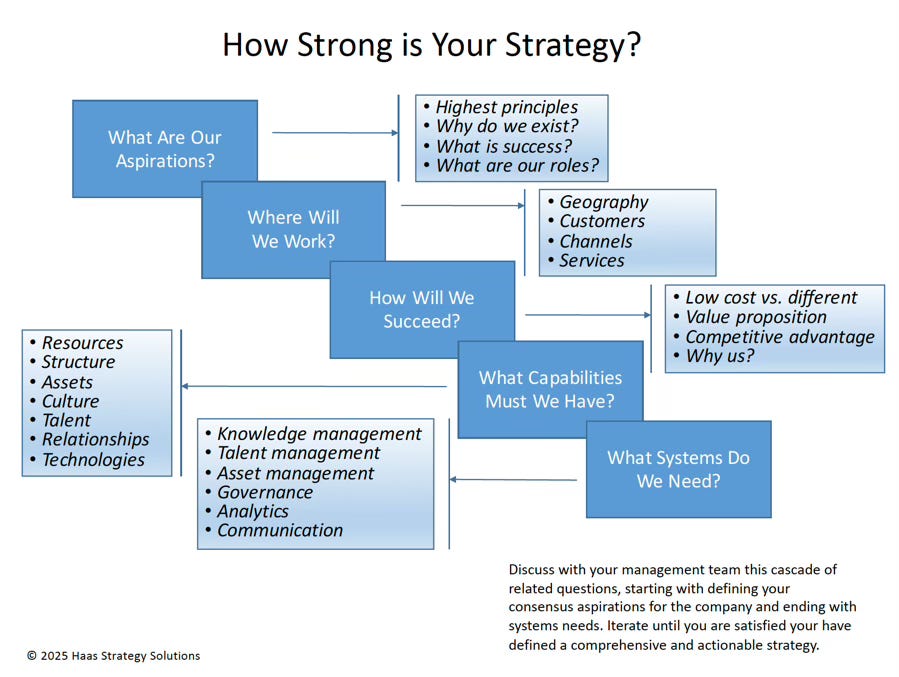
Martin’s framework asks five questions that separate strategy from planning:
What is our winning aspiration? Not a vague mission, but a concrete statement of what winning looks like.
Where will we play? Which customers, geographies, channels, and product categories will we focus on, and which will we avoid?
How will we win? What is our distinctive approach that allows us to beat competitors in our chosen arena?
What capabilities must we have? What do we need to be exceptionally good at to deliver on our how-to-win choice?
What management systems are required? What processes, structures, and metrics will support and reinforce our choices?
A strategic plan might answer questions four and five. A strategy answers all five, in sequence, with each answer constraining the next.
What to Do About It
If you suspect you have a plan but not a strategy, here is where to start.
First, articulate your theory of winning in one paragraph. Not what you do, but why your approach beats the alternatives. If you cannot write this paragraph, you do not yet have a strategy.
Second, list what you have decided not to do. Which customer segments are you deliberately ignoring? Which product categories will you not enter? Which competitors will you not try to match? If this list is empty, your strategy is not yet sharp enough.
Third, test your choices against pressure. If your largest customer left, would your strategy still make sense? If a competitor cut prices 20%, would you follow, or would your strategy give you a reason to hold? If the answer is “it depends,” your strategy is not doing its job.
Strategy is not a document. It is a way of making decisions. The document exists only to capture and communicate the choices so everyone in the organization can make consistent decisions without checking with the CEO.
The Payoff
Companies with clear strategies move faster. Not because they plan better, but because they waste less time debating choices that have already been made. When a new opportunity appears, leaders can quickly assess whether it fits the strategy or distracts from it. When pressure arrives, they know what to protect and what to sacrifice.
Companies with plans but no strategy move more slowly. Every significant decision becomes a negotiation because there is no shared framework for choosing. Leaders optimize their own functions rather than the whole. Resources are spread across too many priorities, and nothing gets done with excellence.
The distinction between strategy and strategic planning is not academic. It shows up in how fast you make decisions, how aligned your team stays under pressure, and whether your direction survives the first real test.
Most companies need fewer planning processes and more strategic clarity. The plan can come later, once you know what you’re actually trying to win.
About the Author
Mark Haas is the founder of Haas Strategy Solutions (HSS). With decades of experience advising $5M–$100M organizations, he helps CEOs trade “Strategy Debt” for Strategic Control. Through a disciplined focus on Strategic Metabolism, HSS installs the governance and behaviors required to pivot faster than the market.
Ready to find your signal in the noise?
The Insight: Subscribe to the Strategic Pulse for weekly briefings on retiring Strategy Debt.
The Diagnostic: Request a Strategy Maturity Session to audit your team’s alignment.
The Partnership: Explore our Sprint, Build, and System engagements at Haas Strategy Solutions.