
Confront Reality First
Strategy begins with seeing clearly. If diagnosis is wrong, execution cannot save you.
Most strategy fails before it starts. Not because the ideas are wrong. Because the diagnosis is.
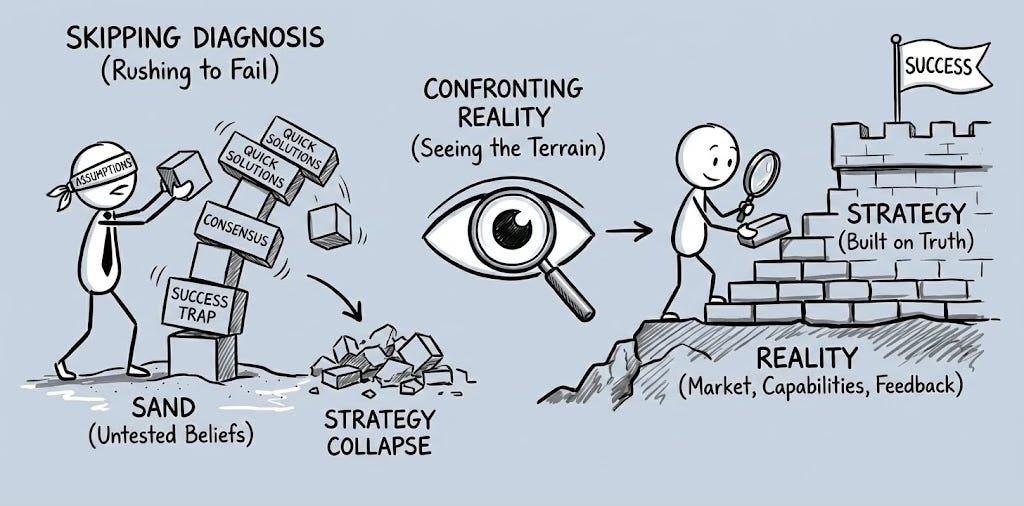
Leaders skip the hard work of seeing their situation clearly. They rush to solutions. They build plans on assumptions they never tested. Then reality arrives, and the strategy collapses.
The first discipline of strategy is not choosing a direction. It is seeing the terrain.
Why Diagnosis Gets Skipped
Diagnosis is uncomfortable. It means admitting what you do not know. It means looking at problems you would rather not see. It means accepting that the story you have been telling yourself and your board may not be true.
Leaders face pressure to act. Boards want plans. Employees want certainty. Investors want growth projections. Nobody wants to hear “we need three months to understand what is actually happening.”
So leaders skip ahead. They pick a direction based on intuition, industry trends, or what worked at their last company. Sometimes they get lucky. More often, they build a strategy on sand.
What Confronting Reality Means
Confronting reality is not pessimism. It is seeing what is actually happening, without the filter of what you wish were true.
This means looking at your market position honestly. Not your brand promise, but what customers actually think when they compare you to alternatives. Not your stated differentiation, but the real reasons customers choose you or choose someone else.
It means understanding your organization’s true capabilities. Not the capabilities on your website, but what your people can actually deliver under pressure. Not your stated culture, but how decisions really get made when resources are tight.
It means seeing the feedback loops in your system. When sales decline, does the organization respond with better products or with more discounting? When a competitor moves, does information flow quickly to decision makers, or does it get filtered through layers until urgency disappears?
The Traps That Block Clear Seeing
Three traps prevent leaders from confronting reality.
The first is success. Organizations that have won in the past assume they understand why. They attribute success to their strategy when luck or market tailwinds did most of the work. They stop questioning because questioning feels disloyal to what got them here.
The second is consensus. Leadership teams develop shared assumptions that nobody challenges. The assumptions become invisible. “Our customers value quality over price” becomes fact, even when no one has tested it in years. Dissent feels risky, so people stay quiet.
The third is speed. The pressure to move fast crowds out reflection. Leaders mistake activity for progress. They launch initiatives before understanding problems. They solve the wrong things quickly.
What to Look For
If you want to see your situation more clearly, start with these questions.
What do customers say about us when we are not in the room? Not in surveys, which invite polite answers. In conversations with people who have no reason to flatter you. The gap between your brand story and their actual experience is diagnostic.
Where do we lose deals? Not the deals you never had a chance to win. The ones where you were a serious contender and something went wrong. The pattern in those losses tells you more than the pattern in your wins.
What decisions take too long? Slow decisions reveal unclear authority, competing priorities, or fear of accountability. They signal where the organization’s structure fights its strategy.
What information do leaders not see? Every organization filters information as it moves up. By the time it reaches executives, bad news has been softened and context has been stripped. Find out what is getting filtered and why.
Where are we fooling ourselves? Every leadership team has at least one belief that feels true but is not. Often, it is about competitive position. Sometimes it is about internal capability. The question is whether you have the discipline to find it before the market does.
The Payoff
Leaders who confront reality catch problems earlier. They notice market shifts before competitors do. They make choices based on what is happening rather than what they hope is happening.
This does not mean paralysis. Diagnosis should lead to action. But action built on clear sight is different from action built on assumption. It adapts when conditions change. It survives contact with reality because it was built on reality.
The Weekly Assumption Scan I described last week is one tool for this. Every week, your leadership team should ask: “What do we believe that we have not tested recently? What would change our strategy if it turned out to be wrong?”
This is not comfortable. It is necessary.
Strategy begins with seeing. Get that right, and the choices become clearer. Get it wrong, and even brilliant execution leads nowhere.